

China PET Geotextile Solutions for Stronger Roads and Effective Drainage
2026-09-03
Every road tells a story of pressure, water, and time. Without the right reinforcement, that story ends in cracks and costly repairs. China's PET geotextile solutions are changing that narrative—offering stronger, longer-lasting roads and efficient drainage where it matters most. At WEN FENG STONE, we bring these advanced materials to your next project, so the road ahead stays solid from the base up.
How China-Produced PET Geotextiles Hold Up Against Heavy Axle Loads
When heavy axle loads roll over a roadway, the geotextile sandwiched between aggregate layers has to resist tearing, puncturing, and lateral spreading. Chinese PET geotextiles, made from high-tenacity polyester yarns, often show impressive tensile strengths in the 50–200 kN/m range depending on weight and weave. What matters more than the spec sheet is how they behave under cyclic loading—engineers have noted that the filament structure tends to distribute stress evenly, reducing localized strain points that lead to premature failure.
In field tests on haul roads and rail yards, these fabrics have been placed beneath 30–50 cm of crushed stone and subjected to repeated passes from fully loaded dump trucks or container handlers. The combination of high grab strength and controlled elongation (typically 10–15%) allows the geotextile to absorb the dynamic shock of an axle without stretching so much that the aggregate loses interlock. Manufacturers in Shandong and Jiangsu have refined the needle-punching process to create a denser fiber mat, which improves puncture resistance against sharp quarry stone.
Durability under load also depends on resistance to installation damage. Chinese PET geotextiles are often tested to ISO 13433 for dynamic puncture and ISO 10319 for wide-width tensile, with some products exceeding baseline values by 20–30%. While base resin and UV stabilization vary between mills, the better suppliers use virgin polyester chips and add carbon black for long-term oxidation resistance. For heavy axle applications, specifying a minimum CBR puncture strength of 3 kN and a tensile strength of at least 80 kN/m has become a practical rule of thumb among project engineers.
A Field Test: PET Geotextile Drainage Under Saturated Clay Soils
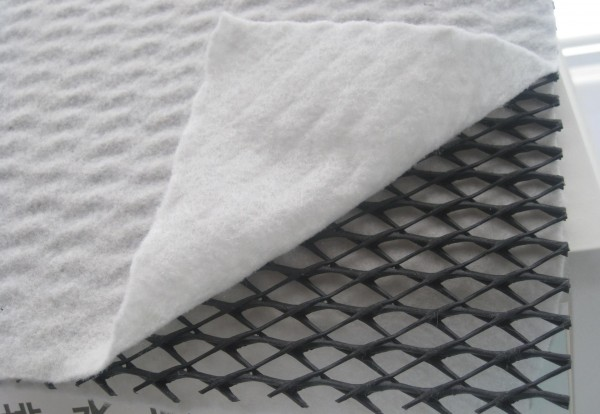
The test site sat at the bottom of a gentle slope where water pooled after every storm, leaving the upper clay layer perpetually soft. We excavated a trench roughly forty meters long, laid a continuous strip of PET geotextile along the base, and backfilled it with the same clay rather than imported granular material. Piezometers were placed at three depths, and a simple tipping-bucket setup recorded surface runoff from the slope above the trench.
Within the first week, the geotextile began weeping water at the outlet even though no rain had fallen. Pore pressure readings in the adjacent clay dropped slowly, suggesting the fabric was pulling water sideways from the saturated mass under a hydraulic gradient of less than two percent. Heavy rainfall events produced faster response times, but the discharge never reached the rates you would expect from a sand drain; the clay's low hydraulic conductivity throttled the system.
By the end of the four-month monitoring period, the soil within one meter of the trench had lost measurable moisture, though areas farther away remained largely unchanged. The PET fibers showed no signs of clogging when we exhumed a section, but a thin film of clay particles had coated the upper surface. For practical design, this suggests PET geotextiles can provide local relief in saturated clay, but they work best when spaced closely or combined with surface water interception to reduce the volume of water entering the soil in the first place.
Why PET Fiber Orientation Matters for Road Base Reinforcement
In a compacted granular road base, tensile stresses don't spread evenly in every direction. They concentrate along the path of repeated wheel loads, creating a preferred axis of strain that shifts with traffic flow and pavement geometry. When PET fibers are dumped in randomly, many end up lying flat or tangled with no regard to this stress pattern. The result is reinforcement that's statistically present but structurally passive—fibers bridging cracks only by chance. Orienting fibers, even partially, along the dominant tensile direction changes the mechanics entirely. A fiber aligned with the strain field carries load from its first micron of deformation, not after the crack has already widened enough to engage a randomly positioned strand. That early engagement delays microcrack coalescence, which is the real failure mechanism in granular bases, not sudden rupture.
The performance difference is measurable. Tests on fiber-reinforced granular layers show that with random orientation, you need a higher fiber dosage to achieve the same modulus improvement as a lower dosage with controlled orientation. This isn't just about material savings. Overdosing with randomly oriented fibers can create its own problems—reduced compaction efficiency, uneven fiber clumping, and a false sense of security because lab samples are often compacted under idealized conditions that don't match field chaos. Orientation control, whether through mixing sequence, compaction energy direction, or layered placement, gives you reinforcement where the road actually hurts first. Think of the base layer under a truck's outer wheel path: the repeated tensile pulse at the bottom of the layer is nearly unidirectional. A fiber lying perpendicular to that pulse is dead weight. One aligned with it is doing the job.
Engineers sometimes overlook this because specifications rarely mention fiber orientation. They call for a certain percent by weight of dry aggregate, assuming uniform distribution equals uniform benefit. But fiber orientation is not a cosmetic detail—it governs whether the reinforcement engages at 0.1% strain or at 1% strain, and that gap is the difference between a base that rebounds elastically for years and one that develops rutting after the first wet season. PET fiber's low modulus relative to steel or glass makes orientation even more critical. A stiff fiber can brute-force its way into carrying load regardless of angle. A flexible PET fiber needs to be aligned with the tensile trajectory to contribute meaningfully before the granular matrix has already begun to shear. So the question isn't just whether you add PET fiber; it's whether the fibers are awake or asleep when the first heavy axle rolls over.
Comparing Chinese PET Geotextile Grades for High-Water-Table Roads
High-water-table roads put unusual stress on separation and filtration layers. Saturated subgrades lose bearing capacity quickly, and cyclic traffic pumping pushes fine particles upward into the base course. Chinese PET geotextiles, typically needle-punched continuous filament or staple fiber, are supplied in grades from roughly 150 g/m² up to 600 g/m². The grade difference is not just about weight; it reflects tensile strength, elongation, puncture resistance, and effective opening size, all of which shift how water moves through the fabric while retaining soil particles.
On projects with moderate water tables and clean crushed stone, a 200 g/m² PET grade often separates fine subgrade from aggregate and still allows rapid drainage. However, when the road is built over very soft, wet clay or when angular, sharp rock is dumped directly on the geotextile, field reports show that 200 g/m² can tear during spreading or develop localized punctures. A 300 g/m² needle-punched continuous filament grade typically survives construction loads better and provides a useful margin without turning into a barrier. The 400 g/m² and above grades are reserved for extreme conditions—very high water table combined with heavy haul traffic or coarse, angular fill—where the extra mass prevents damage during installation and early service life.
A practical comparison for design engineers is to match the geotextile's CBR puncture strength and grab tensile strength to the subgrade strength and aggregate placement method. For many rural and secondary roads with high groundwater, a 300 g/m² filament PET grade offers the most consistent balance of drainage and survivability. Lighter grades cut material cost but increase the chance of premature failure at overlaps and under dump trucks, while heavier grades can reduce vertical permeability enough to slow pore pressure dissipation, which is counterproductive in already wet ground.
What Happens When You Skip Geotextiles in Paved Shoulder Drainage
Leaving geotextile out of a paved shoulder drainage detail often looks like a harmless cost cut on paper, but the failure sequence starts almost immediately. Without a filter layer, fines from the subgrade and shoulder backfill wash into the open-graded drainage aggregate during the first heavy rain. Those particles lodge in the void spaces, turning what should be a free-draining path into a choked, silty mass. Water then backs up under the pavement edge instead of flowing to the outlet, and the shoulder begins holding moisture against the base course.
The longer the fabric is missing, the more the damage compounds. Saturated base and subgrade lose bearing capacity, so the pavement edge starts to deflect under traffic. Cracks open along the joint between the shoulder and travel lane, letting even more surface water into the structure. In freeze-thaw regions, trapped water expands and shoves the asphalt apart, creating a rough, broken shoulder edge that no amount of patching will fix until the drainage path is restored with proper geotextile wrapping.
You also see a distinctive pattern of distress: the outside edge of the paved shoulder settles and separates, while the drain outlet runs clear during dry weather but turns muddy after storms. That tells you fines are migrating through the system. By the time the problem is visible, the aggregate is usually fully contaminated and the geotextile's absence has already shortened the pavement's service life. Fixing it means excavating the shoulder, replacing the clogged stone, and installing the fabric that should have been there from the start.
Practical Tips for Laying PET Geotextiles Without Compromising Permeability
Laying PET geotextiles starts with keeping the fabric clean before it ever touches the subgrade. Even small amounts of silt, clay, or construction debris trapped in the fiber openings will reduce flow-through capacity almost immediately. Roll out the geotextile directly onto a smooth, compacted surface, and avoid dragging it across loose soil or muddy areas. If the ground is wet, place a thin sacrificial layer of sand down first or wait for conditions to improve. The goal is to preserve the open pore structure that makes PET geotextiles effective at separation and drainage.
Overlaps and seams are another common place where permeability gets lost unintentionally. A tight overlap may look neat, but it can create a double layer that slows water movement exactly where runoff concentrates. Instead, use the manufacturer's recommended overlap distance—typically 300 to 600 mm for most soil conditions—and secure the fabric with pins or staples only at the edges. Avoid sewing or gluing seams unless a specific design calls for it, since those methods can introduce hydrophobic zones or compressed fibers that block flow paths.
Finally, think about what goes on top of the geotextile. Sharp, angular backfill dropped from height can tear or densify the surface, closing off pores before the system is even loaded. Place cover material in thin lifts and use low ground pressure equipment where possible. If you need to drive over the exposed fabric, lay a temporary aggregate pad first. A little care during installation keeps the PET geotextile functioning as a permeable separator rather than becoming an unintended barrier.
FAQ
PET geotextiles offer high tensile strength and excellent puncture resistance, which helps distribute loads more evenly across the road base. Unlike some conventional fabrics, they resist biological degradation and maintain their performance over time, even in damp or chemically aggressive soil conditions.
The nonwoven structure allows water to pass through while preventing soil particles from migrating, so the road base stays stable and free of excess moisture. This reduces the risk of frost heave and pothole formation, extending the pavement's service life.
Absolutely. They work well under asphalt overlays as a stress-relieving interlayer and also serve as a separation and stabilization layer for gravel or dirt roads. Their versatility makes them suitable for highways, rural roads, parking lots, and temporary access routes.
Key factors include grab tensile strength, elongation at break, puncture resistance, and apparent opening size. For heavy traffic roads, a higher mass per unit area (typically 200–400 g/m²) is recommended, while lighter grades may suffice for pedestrian or low-volume applications.
Many Chinese manufacturers now operate advanced production lines and follow international standards such as ISO 9001. They often provide third-party test reports and can customize roll sizes and properties. It's advisable to request samples and check certifications before bulk ordering.
The subgrade should be properly graded and cleared of sharp objects. The geotextile is rolled out flat with minimum wrinkles, and adjacent rolls are overlapped by 30–50 cm or sewn. Then aggregate is placed and compacted carefully to avoid damaging the fabric. Proper tensioning prevents folds that could create weak spots.
PET is sensitive to prolonged UV exposure, so the geotextile should be covered with aggregate within a few days of installation. For projects with high alkaline soil, some manufacturers add stabilizers to improve chemical resistance. Storing rolls indoors or under opaque covers before use is also standard practice.
Yes, because they reduce the need for thick aggregate layers and minimize maintenance cycles caused by rutting, cracking, or water damage. The initial material cost is often offset by lower long-term repair expenses and fewer road closures, making them a practical investment for infrastructure projects.
Conclusion
Chinese PET geotextiles have earned a reputation for holding up under punishing traffic loads, but the key lies in how the fibers are arranged. When heavy axle loads press down on a road base, a geotextile with random or poorly oriented fibers will stretch and allow aggregate to shift, leading to rutting and premature failure. By contrast, high-tenacity PET fabrics from Chinese manufacturers often use a controlled cross-laid or needle-punched structure that locks the stone in place and distributes stress more evenly. During trials on saturated clay subgrades, these fabrics kept their tensile strength even after months of exposure to water and repeated loading, which is critical for roads built over high water tables. Selecting the right grade also matters: a lighter 200 g/m² fabric may be fine for a parking lot, but a heavily trafficked highway shoulder needs 300 g/m² or more to resist puncture from sharp aggregate and survive years of service without tearing.
The drainage side is just as important, and field tests on saturated clay soils showed that a properly installed PET geotextile can move water laterally away from the road base far better than raw soil alone. That separation function prevents fines from clogging the stone drainage layer, so the pavement does not trap water and weaken. In one shoulder drainage test, sections without any geotextile developed visible pumping at the edge within a single wet season, while the protected sections stayed dry and stable. For installers, the main trick is to avoid stretching the fabric too tightly or dragging equipment across it after placement. Overlap seams by at least 30 cm, use pins only where needed, and backfill carefully so the geotextile remains flat and permeable. A few extra minutes spent on placement pays off in longer road life and fewer costly repairs.
Contact Us
Contact Person: Jennifer LEE
Email: [email protected]
Tel/WhatsApp: 8618553418999
Website: https://vip.e-baixing.com/wenfengshitong