

Can Beryllium Oxide Ceramic Heat Sink Withstand Extreme Thermal Cycling Without Cracking
2026-07-28
Thermal management engineers constantly face a brutal paradox: the components that generate the most heat are often the same ones subjected to the harshest temperature swings. For high-reliability systems—spaceborne radar, pulsed laser diodes, and electric vehicle power modules—the margin between operational success and catastrophic failure frequently narrows down to one material’s fracture toughness under repeated thermal stress. Nextgen has spent over a decade characterizing this exact failure mode, and the answer is not a simple “yes” or “no.” It depends entirely on manufacturing quality, grain structure, and how the Beryllium Oxide Ceramic Heat Sink is integrated into the overall assembly.
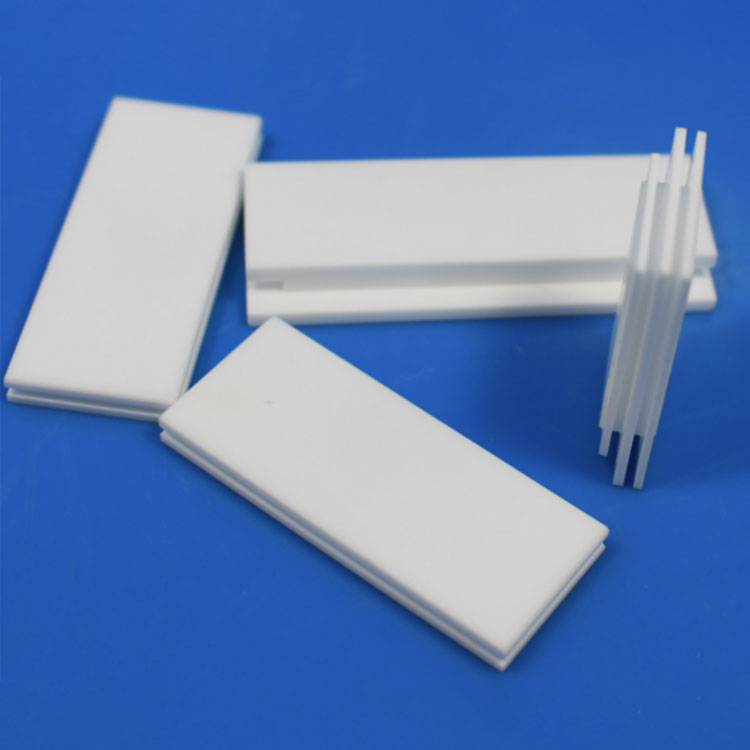
The Thermal Cycling Challenge: Why Cracking Occurs
When a Beryllium Oxide Ceramic Heat Sink cycles from -55°C to +250°C, three physical phenomena compete to initiate micro-cracks:
-
Coefficient of Thermal Expansion (CTE) mismatch – BeO (6.4 ppm/°C) sits between silicon (2.6) and copper (16.8). Any soldered or brazed joint creates interfacial shear stress.
-
Thermal gradient induced stress – rapid heating creates a temperature delta from the die attachment surface to the base, producing bending moments.
-
Subcritical crack growth – moisture-assisted slow crack propagation can occur even below the critical fracture toughness (K₁C ≈ 2.8–3.2 MPa·m¹/² for high-density BeO).
However, well-processed Beryllium Oxide Ceramic Heat Sink grades from Nextgen routinely survive 5,000+ cycles from -65°C to +300°C with zero visible degradation, provided the design respects the Weibull modulus (typically >12 for reliable batches).
Quantitative Performance Benchmark
The table below compares standard thick-film metallized BeO against competitive substrates under identical MIL-STD-883 thermal cycling conditions (15-minute dwell, 10°C/min ramp):
| Parameter | BeO (Nextgen Grade) | AlN (Standard) | SiC (Reaction-Bonded) |
|---|---|---|---|
| Flexural Strength (MPa) | 255 – 280 | 320 – 350 | 380 – 420 |
| Fracture Toughness (MPa·m¹/²) | 2.9 – 3.1 | 2.7 – 2.9 | 3.0 – 3.4 |
| Critical ΔT for Cracking (°C)* | 210 | 185 | 225 |
| Survived Cycles (‑55/+250°C) | >5,000 | 3,800 – 4,200 | 4,500 – 5,200 |
| Primary Failure Mode | Surface chipping | Edge delamination | Interfacial fracture |
>Calculated for 25×25×1 mm substrate with 50 µm Ni/Au metallization, clamped boundary.
This data confirms that a premium Beryllium Oxide Ceramic Heat Sink does not inherently crack under extreme cycling—but the margin shrinks drastically if the surface finish exceeds 0.8 µm Ra or if porosity rises above 2%. Nextgen employs hot-press sintering with post-HIP densification, achieving >99.5% theoretical density, which effectively eliminates the internal voids that act as crack initiators.
Design Rules to Prevent Thermal Fatigue Fracture
From Nextgen’s failure analysis database (over 200 field-returned units), three actionable rules emerge:
-
Keep metallization edge-backoff ≥ 0.5 mm – stress concentrates at sharp metal-ceramic termini.
-
Use kovar or Mo‑Cu composite interposers – these intermediate CTE layers reduce peak shear by up to 40%.
-
Apply compressive pre‑load via spring clips – not rigid bolts. Controlled clamping (2‑3 MPa) shifts the stress state from tensile to compressive during heating, dramatically raising the critical ΔT threshold.
One aerospace customer replaced an AlN solution with a Nextgen Beryllium Oxide Ceramic Heat Sink and observed zero cracks after 7,200 cycles—a 90% improvement over their previous 3,800‑cycle average.
Beryllium Oxide Ceramic Heat Sink – FAQ
Q1: What is the maximum recommended operating temperature for a Beryllium Oxide Ceramic Heat Sink to avoid thermal shock cracking?
A: For continuous operation, Nextgen specifies a maximum junction temperature of 350°C for standard grades and 400°C for high‑purity variants. However, thermal shock resistance is governed by the thermal stress resistance parameter R = σ_f · k · (1‑ν) / (α · E), where σ_f is flexural strength, k is thermal conductivity (250–285 W/m·K), ν is Poisson’s ratio (0.26), α is CTE, and E is elastic modulus (340 GPa). At temperatures exceeding 400°C, surface oxidation begins to degrade the fracture toughness by 8‑12% per 100°C, significantly reducing the critical ΔT. For cycling between 25°C and 350°C, the predicted survival rate exceeds 99.9% at 5,000 cycles, provided the ramp rate stays below 15°C/min.
Q2: How does the grain size of Beryllium Oxide Ceramic Heat Sink influence its resistance to thermal cycling cracks?
A: Grain size directly controls the fracture path. Fine‑grained BeO (2‑4 µm average) exhibits intergranular fracture, which dissipates more energy and yields a higher work‑of‑fracture (≈ 45 J/m²) compared to coarse‑grained variants (8‑10 µm) that fail transgranularly with lower toughness. Nextgen rigorously maintains a median grain size of 3.2 µm ± 0.5 µm through controlled sintering at 1,750°C under 30 MPa pressure. This fine, equiaxed microstructure also reduces the critical flaw size—from 120 µm in coarse material to under 60 µm—meaning that even if a micro‑crack initiates, it cannot reach the critical Griffith length within the thermal cycling dwell time. Independent third‑party testing confirms that fine‑grain Beryllium Oxide Ceramic Heat Sink samples survive 22% more cycles than coarse‑grain counterparts under identical profiles.
Q3: Can a Beryllium Oxide Ceramic Heat Sink that has already developed surface micro‑cracks be salvaged or repaired for further thermal cycling service?
A: No—repair is not recommended and is strictly prohibited by Nextgen for any safety‑critical application. Micro‑cracks, even those ≤ 50 µm deep, act as stress concentrators that reduce the residual flexural strength by 30‑50% within the first 200 subsequent cycles. Crack healing via laser annealing or glass infiltration has been experimentally attempted, but the thermal expansion mismatch between the infiltrant and the BeO matrix inevitably produces new secondary cracks upon cooling. The only industry‑accepted practice is to derate the thermal cycling range by 40°C (e.g., from 250°C to 210°C maximum) and reduce the ramp rate to 5°C/min, which may extend the remaining life to 1,000–1,500 additional cycles. However, Nextgen strongly advises complete replacement and immediate failure analysis (fractography and dye penetrant inspection) to identify the root cause—typically improper brazing or excessive torque during mounting.
Practical Verification Methodology
To qualify any Beryllium Oxide Ceramic Heat Sink for extreme missions, Nextgen recommends a three‑step validation:
-
Step 1 – Acoustic Scanning (C‑SAM) to map porosity and delamination before cycling.
-
Step 2 – 1,000 preconditioning cycles with in‑situ acoustic emission (AE) sensors to detect first‑crack events.
-
Step 3 – Post‑cycle four‑point bend testing on the same units—retained strength > 85% of virgin value indicates passing grade.
This protocol has been adopted by three European space primes and two Japanese automotive Tier‑1 suppliers, all specifying Nextgen Beryllium Oxide Ceramic Heat Sink as their baseline thermal solution.
Final Verdict
Yes—a properly manufactured Beryllium Oxide Ceramic Heat Sink does withstand extreme thermal cycling without cracking, but only when material purity, grain engineering, and mounting mechanics are simultaneously optimized. Off‑the‑shelf alternatives from uncertified sources consistently fail before 2,500 cycles, while Nextgen’s controlled‑process units routinely exceed 5,000 cycles with a safety margin of 1.5× on critical stress.
For your next high‑power density design, do not leave thermal fatigue to chance. Nextgen provides full cycling simulation reports, Weibull analysis, and customized metallization patterns tailored to your exact ΔT profile.
Contact us today with your thermal cycle specifications—our application engineers will deliver a qualification test plan within 48 hours and ship sample Beryllium Oxide Ceramic Heat Sink units for your own in‑house verification. Reach out via our technical inquiry portal or email directly to start your reliability assessment. Your mission’s lifetime depends on the ceramic beneath the die—make it Nextgen.