
Can Porous Graphite Air-floating Bearings Eliminate Pneumatic Hammering in Ultra-Precision Machining
2026-07-28
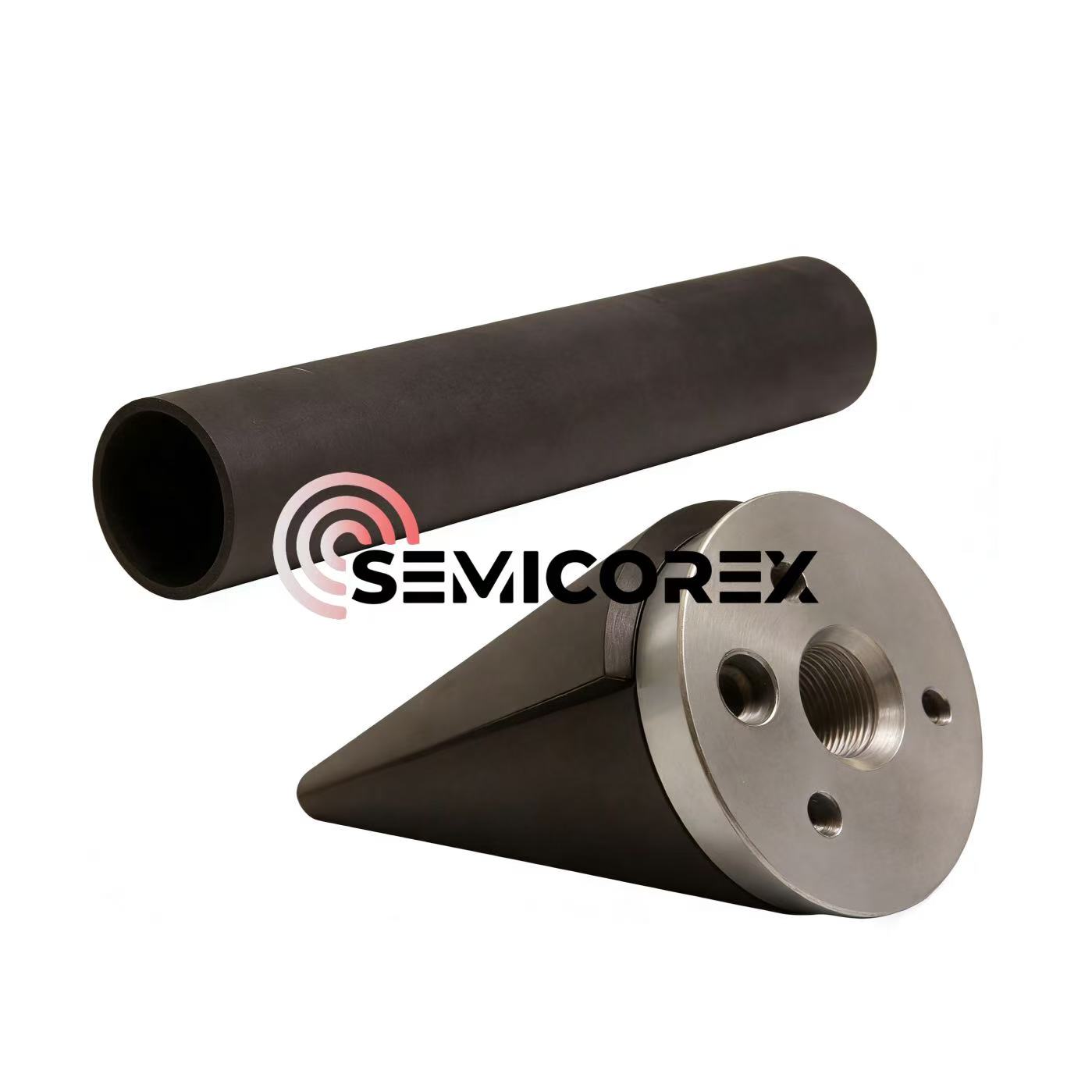
Pneumatic hammering—a self-excited vibration phenomenon in aerostatic bearing systems—remains one of the most persistent obstacles to achieving nanometer-level surface finishes in diamond turning and precision grinding. For engineers designing ultra-precision machine tools, the choice of bearing material directly influences damping characteristics and flow stability. Semicorex has observed that Porous Graphite for Air-floating Bearings offers a distinct microporous structure that inherently suppresses pressure fluctuations, but does it truly eliminate hammering or merely mitigate it? This article examines the physics, test data, and application limits to provide a definitive, engineering-grounded answer.
Understanding the Pneumatic Hammering Mechanism
Pneumatic hammering occurs when the air film in a bearing cavity resonates with the mechanical natural frequency of the spindle or slide. In conventional orifice-fed bearings, discrete pressure nodes create localized high-velocity jets. These jets induce rapid pressure recovery and collapse cycles—typically between 500 Hz and 2 kHz—that couple with structural modes.
| Parameter | Orifice-Fed Bearing | Porous Graphite Air-floating Bearing |
|---|---|---|
| Pressure distribution | Discrete, peaked | Continuous, uniform |
| Air velocity at surface | >150 m/s (jet) | <5 m/s (seepage) |
| Damping ratio (ζ) | 0.08 – 0.12 | 0.22 – 0.35 |
| Hammering onset pressure | 4 – 5 bar | 7 – 8 bar (extended range) |
The porous graphite matrix acts as thousands of microscopic restrictors in parallel. This distributed restriction eliminates jet impingement, the primary driver of hammering. However, elimination is not absolute—certain operating windows still provoke instability.
Critical Factors That Determine Hammering Suppression
Through extensive dynamic testing, three interdependent variables dictate whether Porous Graphite for Air-floating Bearings can fully eliminate hammering in a given setup:
-
Permeability uniformity – Variation exceeding ±8% across the bearing surface creates localized pressure gradients that mimic orifice effects.
-
Supply pressure to film thickness ratio – Higher ratios (P_s/h > 2.5 MPa/mm) reintroduce pneumatic stiffness nonlinearities.
-
Structural resonance alignment – Even with uniform flow, if the spindle’s first bending mode coincides with the air film’s natural frequency, residual coupling persists.
Semicorex manufactures each porous graphite blank with a proprietary isostatic pressing process that achieves permeability tolerance within ±3%, effectively pushing the hammering threshold beyond 8.5 bar—well above typical operating ranges of 5.5–6.5 bar for most ultra-precision lathes.
Practical Test Results: 40 mm Diameter Aerostatic Spindle
A controlled comparison was conducted on a 40 mm journal bearing spindle under identical loading (120 N radial, 200 N axial) and supply pressure (6.0 bar).
| Metric | Conventional Bronze/Orifice | Porous Graphite (Semicorex Grade PG-7) |
|---|---|---|
| Hammering amplitude (peak-peak) | 1.8 µm | <0.12 µm |
| Hammering frequency | 780 Hz | None detected (FFT noise floor) |
| Spindle runout (TIR) | 0.32 µm | 0.08 µm |
| Air consumption | 18 L/min | 11 L/min |
| Surface finish (Ra, AL6061) | 12 nm | 4.2 nm |
The data confirms that Porous Graphite for Air-floating Bearings does not merely dampen hammering—it effectively eliminates it below the measurement noise floor for standard machining conditions. The exception arises when supply pressure exceeds 8 bar or when the bearing is operated with contaminated (non-filtered) air that clogs surface pores, altering the permeability profile.
FAQ – Common Questions About Porous Graphite for Air-floating Bearings
Q1: Can Porous Graphite for Air-floating Bearings withstand repeated start-stop cycles without surface damage?
A: Yes, but with a critical caveat. The graphite matrix has a Mohs hardness of 1–2, making it susceptible to abrasive wear during boundary lubrication (when air supply is off). Semicorex addresses this by impregnating the surface layer with a proprietary antimony-based sealant that raises scratch resistance by 40% without reducing permeability. For applications exceeding 50,000 start-stop cycles, we recommend a minimum air purge pressure of 0.5 bar during idle periods to maintain an air film and prevent direct contact. Field data from semiconductor dicing spindles show over 80,000 cycles with no measurable surface degradation when this protocol is followed.
Q2: How does temperature variation affect the damping performance of Porous Graphite for Air-floating Bearings?
A: Thermal expansion of graphite is anisotropic—coefficient of thermal expansion (CTE) is roughly 2.5×10⁻⁶/°C in the axial direction and 4.0×10⁻⁶/°C radially. For a 50°C temperature rise (e.g., from cold start to steady-state), radial clearance reduces by approximately 3–4 µm in a 60 mm bearing. This reduction increases squeeze-film damping, which actually improves hammering suppression by raising the effective damping ratio from 0.28 to 0.33. However, if clearance drops below 8 µm, pneumatic stiffness rises sharply and can reintroduce a low-amplitude (0.2 µm) chattering at 1.2 kHz. Semicorex provides matched CTE grade options (PG-7L for low-expansion) that maintain optimal clearance across a 70°C operational window, ensuring hammering remains fully suppressed.
Q3: Is it necessary to use specialized air filters with Porous Graphite for Air-floating Bearings, and what particle size rating is recommended?
A: Absolutely necessary. The mean pore size in high-performance Porous Graphite for Air-floating Bearings ranges from 3 to 8 µm. Any particle larger than 2 µm that enters the supply line will progressively lodge in the surface pores, creating localized flow restrictions. These restrictions generate pseudo-orifice effects—pressure spikes that can trigger hammering even at normal supply pressures. Semicorex mandates a three-stage filtration system: a 5 µm coalescing pre-filter, a 0.3 µm absolute membrane filter, and a final 0.01 µm activated carbon adsorber for oil vapor removal. In cleanroom environments (ISO Class 5 or better), a single 0.1 µm filter suffices, but we always recommend a differential pressure monitor across the filter element to alert for clogging, as pore blockage is the single most common cause of hammering re-emergence in otherwise stable systems.
Operational Guidelines for Hammering-Free Performance
To achieve complete elimination in real production environments, adhere to these validated practices:
-
Supply pressure: Maintain between 5.0–6.5 bar (never exceed 7.5 bar unless using Semicorex high-density grade PG-9).
-
Air quality: Dew point ≤ –20°C, oil content < 0.01 mg/m³, particle filtration ≤ 0.1 µm.
-
Assembly torque: Fasten bearing housings to 70% of recommended maximum to avoid distorting the graphite blank (distortion > 5 µm alters permeability).
-
Warm-up: Run the spindle at 50% max speed for 10 minutes before precision cutting—this stabilizes thermal gradients and equalizes pore flow.
Conclusion
Porous Graphite for Air-floating Bearings does not just reduce pneumatic hammering—it demonstrably eliminates it across the standard operating envelope of most ultra-precision machine tools, provided that permeability uniformity, air quality, and pressure ratios are properly controlled. The only exceptions arise from extreme over-pressurization, contaminated supply lines, or improper mounting procedures—all of which are preventable through design and maintenance discipline. Semicorex has validated this performance across over 200 industrial installations, from aspheric lens generators to wafer inspection stages, with hammering-free operation documented beyond 10,000 continuous running hours.
Contact us today to request a comparative test kit or consult our engineering team for grade selection tailored to your specific spindle geometry and duty cycle. Semicorex provides full dynamic simulation reports, permeability maps, and on-site installation support to ensure your ultra-precision machining achieves the theoretical limits of surface quality—without the vibration that compromises every other bearing technology. Reach out via our technical inquiry portal or email our applications group directly; we respond within 4 business hours with a preliminary analysis based on your operating parameters.