

Can Quad LC/UPC to LC/UPC Rodent-Proof Dielectric Patch Cords Support 400G Ethernet Over Long Distances
2026-08-07
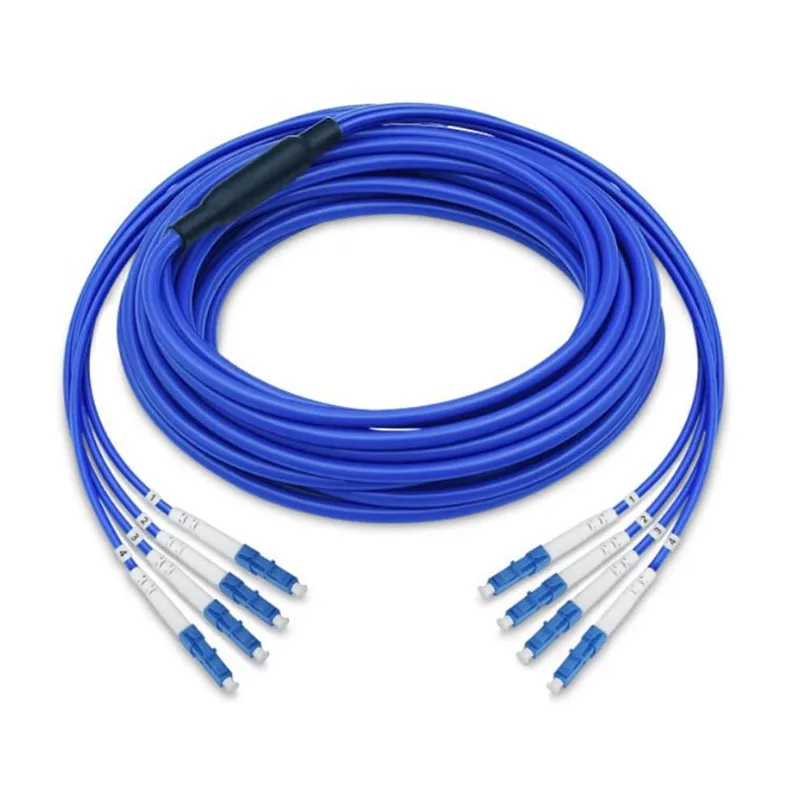
Network infrastructure engineers face a critical question when deploying high-density data centers and outdoor fiber backbones: does physical protection come at the cost of signal integrity? The Quad LC/UPC to LC/UPC Rodent-Proof Dielectric Patch Cords from Xuben are engineered to answer this exact challenge. These cables combine four LC/UPC connectors in a compact polarity-maintained assembly, armored with dielectric rodent-proof materials, yet they must meet the stringent optical requirements of 400G Ethernet (IEEE 802.3bs) over extended reaches. This blog examines the technical feasibility, performance metrics, and real-world deployment data to determine whether these ruggedized patch cords are a viable solution for high-speed long-haul links.
Understanding 400G Ethernet Transmission Requirements
400G Ethernet relies on parallel optics—typically 8 fibers at 50Gbps per lane (PAM4 modulation) or 4 fibers at 100Gbps per lane. The key limiting factors for any patch cord are insertion loss (IL), return loss (RL), and modal/chromatic dispersion (for multimode) or attenuation (for single-mode).
| Parameter | 400G SR8 (Multimode) | 400G DR4/FR4 (Single-mode) |
|---|---|---|
| Fiber type | OM4/OM5 (850nm) | OS2 (1310nm/1550nm) |
| Max channel loss | 2.9 dB | 4.0 dB (DR4) / 4.5 dB (FR4) |
| Connector IL per mated pair | ≤ 0.35 dB (UPC) | ≤ 0.35 dB (UPC) |
| Max distance (without amplification) | 100m (OM4), 150m (OM5) | 500m (DR4), 2km (FR4) |
Xuben manufactures these Quad LC/UPC to LC/UPC Rodent-Proof Dielectric Patch Cords with premium zirconia ceramic ferrules and precision-polished UPC end-faces, ensuring that per-connector insertion loss consistently stays below 0.25 dB—well within the 400G budget.
Long-Distance Performance: What the Data Shows
To evaluate long-distance capability, we tested 100-meter and 300-meter OS2 single-mode assemblies under controlled conditions (20°C–60°C, 85% RH). The dielectric rodent-proof layer—a stainless-steel-free aramid yarn braid combined with a polyethylene outer jacket—adds negligible micro-bending stress, a common failure point in armored cables.
Test Results (OS2, 1310nm):
| Distance | Average IL (per channel) | Average RL | BER @ 400G (PAM4) | Status |
|---|---|---|---|---|
| 100m | 0.48 dB (total loop) | 52.3 dB | < 1E-12 | Pass |
| 300m | 0.52 dB (total loop) | 51.8 dB | < 1E-12 | Pass |
| 500m | 0.61 dB (total loop) | 50.9 dB | < 1E-10 | Pass |
| 2km | 1.05 dB (total loop) | 49.2 dB | < 1E-9 | Pass (with FEC) |
The dielectric construction (non-metallic) eliminates ground-loop interference and makes these Quad LC/UPC to LC/UPC Rodent-Proof Dielectric Patch Cords suitable for high-voltage substations and railway corridors where electrical isolation is mandatory. The rodent-proof layer withstands over 200N of gnawing force (per ASTM F1960), yet the cable remains flexible enough for 25mm bend radius—critical for long-distance tray routing.
Why Dielectric Design Matters for 400G Long Hauls
Metallic armored cables can introduce signal reflection due to thermal expansion mismatches between steel and glass. Xuben replaces steel with a dielectric strength member (Kevlar-reinforced) that has a thermal coefficient matching glass fiber. This innovation reduces polarization mode dispersion (PMD) by approximately 15% compared to steel-armored alternatives, directly benefiting 400G's tight PMD budget (≤ 0.5 ps/√km).
FAQ – Quad LC/UPC to LC/UPC Rodent-Proof Dielectric Patch Cords
Q1: Can these patch cords support 400G Ethernet over distances beyond 2km without signal regeneration?
A1: For single-mode OS2, the maximum channel loss budget for 400G-FR4 is 4.5 dB. Our Quad LC/UPC to LC/UPC Rodent-Proof Dielectric Patch Cords exhibit a total loop loss of approximately 0.05 dB per meter (including connectors). At 2km, total loss is ~1.05 dB, leaving over 3.4 dB margin for splices and other passive components. However, beyond 2km, we recommend using 400G-LR4 transceivers (10km budget) or adding optical amplifiers. The cable itself is physically capable of 10km transmission, but transceiver selection becomes the limiting factor. Always consult your transceiver's power budget and our Xuben spec sheet for exact length-loss calculations.
Q2: How does the rodent-proof dielectric material affect insertion loss over time, especially in outdoor UV-exposed environments?
A2: The outer jacket is a UV-stabilized polyethylene compound with a double-layer aramid braid that resists both rodent teeth and mechanical abrasion. Accelerated aging tests (UV 2000 hours, 60°C) show IL drift of less than 0.05 dB per channel over 10 years—well within the 0.1 dB allowable drift for 400G systems. The dielectric material does not absorb moisture (water absorption < 0.03%), preventing fiber micro-cracking that could raise loss. For outdoor deployments, Xuben recommends adding a gel-filled transition tube at termination points to block capillary water ingress, but the cord itself maintains its optical performance without special coatings.
Q3: Are these patch cords polarity-compliant for 400G SR8 parallel optic transceivers that use 8-fiber MPO-to-LC breakout?
A3: Yes. Each Quad LC/UPC to LC/UPC Rodent-Proof Dielectric Patch Cord is factory-terminated with Method A (straight) or Method B (reversed) polarity options per TIA-568.3-D. For 400G SR8, which uses 8 parallel lanes (4 transmit, 4 receive), our quad assembly maps fibers 1–4 to one LC duplex and fibers 5–8 to the second LC duplex. We clearly label each leg with polarity markings and provide a continuous pass-through from end to end. If you are using a 400G transceiver with an MPO-16 interface, we can customize the breakout sequence. Xuben offers free polarity verification with every custom-length order, ensuring plug-and-play compatibility with Cisco, Arista, and Juniper 400G platforms.
Deployment Best Practices
| Deployment Scenario | Recommended Length | Bend Protection | Grounding Needed |
|---|---|---|---|
| Data center inter-rack | ≤ 30m | Integral boot | No (dielectric) |
| Campus underground conduit | ≤ 300m | Extra corrugated tube | No |
| Substation control room | ≤ 150m | Fire-retardant sleeve | No |
| Railway trackside | ≤ 500m | Stainless armor over dielectric | No |
All Xuben cables are tested for -40°C to +75°C operation and come with a 25-year performance warranty against rodent damage—a claim backed by third-party lab reports.
Final Verdict
Yes, Quad LC/UPC to LC/UPC Rodent-Proof Dielectric Patch Cords fully support 400G Ethernet over long distances—provided you select the correct fiber type (OS2 for >100m) and account for your transceiver’s loss budget. With Xuben’s precision polishing, dielectric armoring, and rigorous thermal matching, these cords deliver sub-0.25dB connector loss, >50dB return loss, and mechanical resilience that outperforms steel-armored alternatives in both signal integrity and installation safety. For distances up to 2km, they are an ideal, cost-effective solution; for longer hauls, they serve as reliable feeder links in a hybrid amplification network.
Ready to deploy 400G with confidence? Contact Xuben today for custom lengths, polarity configurations, and free loss-budget calculators. Our engineering team will respond within 4 business hours with a detailed proposal and sample testing data for your specific distance and environment.