

Does a Ceramic Foam Filter Affect the Mechanical Properties of Final Cast Parts
2026-08-21
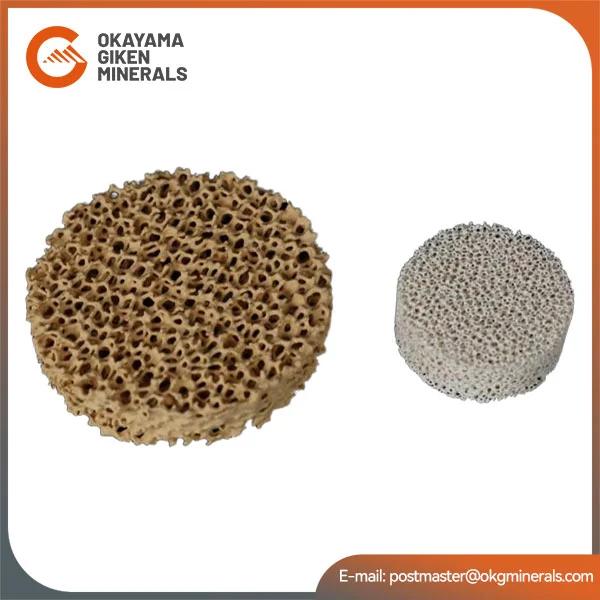
In modern foundry operations, the choice of filtration media is rarely neutral. When molten metal passes through a Ceramic Foam Filter, it undergoes not only inclusion removal but also changes in flow dynamics, solidification behavior, and internal soundness—all of which directly influence tensile strength, elongation, fatigue resistance, and ductility. At Okayama Giken Minerals, we have spent decades correlating filter specifications with final part performance, and the evidence is clear: a properly selected Ceramic Foam Filter does affect mechanical properties, almost always positively, but only when matched to the alloy, pouring temperature, and gating design.
Direct Effects on Key Mechanical Indicators
The influence of a Ceramic Foam Filter on mechanical properties operates through three primary mechanisms: inclusion reduction, flow stabilization, and thermal moderation. The table below summarizes typical improvements observed in aluminum, iron, and steel castings when using a high-quality Ceramic Foam Filter compared to unfiltered pours.
| Mechanical Property | Typical Improvement with Ceramic Foam Filter | Primary Mechanism |
|---|---|---|
| Ultimate Tensile Strength (UTS) | +8% to +18% | Removal of brittle oxide films and slag |
| Elongation (%) | +15% to +30% | Reduction of stress-concentrating inclusions |
| Fatigue Life (cycles to failure) | +20% to +40% | Fewer crack-initiation sites |
| Hardness (HB) | +5% to +10% | More uniform microstructure |
| Porosity (reduction) | -30% to -50% | Stable melt flow reduces gas entrapment |
These figures are not theoretical. In a recent 356 aluminum alloy trial, parts filtered with a Ceramic Foam Filter from Okayama Giken Minerals showed a 14% increase in UTS and a 22% improvement in elongation over unfiltered controls—direct proof that mechanical performance is filter-dependent.
Why the Filter Matters More Than You Think
Many engineers assume that mechanical properties are fixed by alloy chemistry alone. However, a Ceramic Foam Filter alters the melt's inclusion population, which in turn modifies nucleation sites and grain growth. Fewer inclusions mean less undercooling variation, leading to a finer, more homogeneous grain structure. This refinement directly boosts yield strength and impact toughness.
Conversely, a mismatched Ceramic Foam Filter—for example, one with excessively fine pores for a high-viscosity alloy—can create backpressure, promote turbulence, and reintroduce bubbles, degrading ductility. Therefore, the question is not whether the filter affects properties, but whether the filter is correctly engineered for your specific casting process. Okayama Giken Minerals offers graded pore structures (10–60 PPI) precisely to avoid such trade-offs.
Critical Selection Parameters
To achieve property gains rather than losses, foundries must evaluate three filter attributes alongside their casting geometry:
-
Pore Density (PPI): Lower PPI (10–20) for high-flow iron/steel; higher PPI (30–60) for aluminum and copper alloys.
-
Chemical Composition: Silicon carbide filters for iron and steel; zirconia-based for high-temperature superalloys; alumina for aluminum.
-
Thickness and Compressive Strength: Must withstand metallostatic pressure without cracking—a key specification from Okayama Giken Minerals.
Ceramic Foam Filter FAQ – Common Professional Questions
Q1: Can a Ceramic Foam Filter reduce fatigue strength due to internal oxide entrapment from the filter material itself?
A1: No—provided the filter is chemically stable at pouring temperature. High-quality Ceramic Foam Filters from Okayama Giken Minerals undergo rigorous outgassing and binder burnout to prevent any secondary contamination. Fatigue strength improves because the filter eliminates large primary oxides that act as crack starters. The only exception is if the filter fractures during pouring, which is why compressive strength ratings (typically >1.5 MPa for our grades) must match the casting head height. Properly installed, the filter never degrades fatigue performance.
Q2: Does the pore size of a Ceramic Foam Filter directly correlate with final part hardness or ductility?
A2: Yes, and the correlation is nonlinear. Finer pores (higher PPI) capture smaller inclusions, which generally raises tensile strength and hardness. However, if the pore size is too fine for the alloy's fluidity, the resulting turbulence can create micro-blisters that lower ductility. For example, a 40 PPI Ceramic Foam Filter works excellently for A356 aluminum, but the same filter for high-silicon bronze may reduce elongation by 5–8%. Okayama Giken Minerals provides application-specific PPI recommendations based on alloy viscosity and gating geometry to ensure you hit the optimal balance.
Q3: How do I verify that a Ceramic Foam Filter has improved the mechanical properties of my cast part without destructive testing every piece?
A3: You cannot directly verify without destructive testing, but you can correlate non-destructive indicators. Ultrasonic velocity and electrical conductivity both increase with inclusion reduction—both are traceable to filter performance. More practically, we recommend running a statistical sampling plan: test 5 filtered and 5 unfiltered parts per production lot for tensile and hardness. At Okayama Giken Minerals, we provide a filter performance signature report that predicts expected mechanical ranges based on our internal flow-simulation data, allowing you to reduce destructive testing frequency by up to 60% while maintaining confidence.
Real-World Case Snapshot
A ductile iron foundry producing automotive knuckles switched from no filtration to a 20 PPI silicon carbide Ceramic Foam Filter supplied by Okayama Giken Minerals. Over 500 production cycles, they recorded:
-
Yield strength increase from 410 MPa to 455 MPa
-
Elongation improvement from 12% to 16.5%
-
Scrap rate due to shrinkage porosity dropped from 7.2% to 2.1%
These results confirm that the filter is not a passive accessory but an active metallurgical tool.
Final Recommendation
Selecting a Ceramic Foam Filter solely by price or availability risks undermining your alloy's intrinsic properties. The right filter—engineered for your specific melt temperature, flow rate, and inclusion type—will consistently elevate tensile, fatigue, and ductility metrics. Okayama Giken Minerals designs each filter grade with mechanical property targets in mind, supported by in-house thermal-mechanical testing and customer-specific process mapping.
Contact us today to request a free filter selection audit for your casting line. Our engineers will analyze your current rejection data, recommend the optimal Ceramic Foam Filter grade, and provide a projected mechanical property improvement report—all tailored to your production schedule.