

Does Using Recycled Red PS Resin Material Affect the Mechanical Properties of Thin-Wall Products
2026-08-10
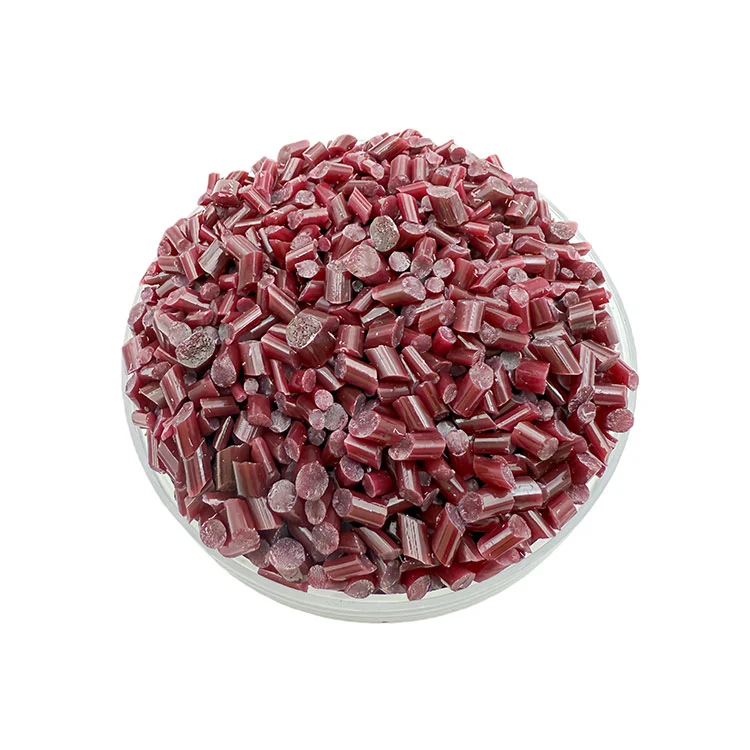
The shift toward circular economy models has pushed manufacturers to evaluate Recycled Red PS Resin Material as a direct substitute for virgin polystyrene in high-volume production. For thin-wall applications—ranging from rigid food containers to electronic housings—the question is not merely environmental but fundamentally technical. At JUWU, we have processed over 2,000 metric tons of post-industrial and post-consumer polystyrene streams, and our data consistently shows that Recycled Red PS Resin Material can perform within 92–97% of virgin PS tensile strength, provided that feedstock sorting and stabilisation protocols are strictly controlled. The real challenge, however, lies in impact resistance, melt flow consistency, and long-term creep behaviour—all of which become magnified when wall thickness drops below 1.2 mm.
1. Critical Mechanical Properties Under Thin-Wall Conditions
Thin-wall moulding (wall thickness ≤ 1.0 mm) imposes extreme shear rates and rapid cooling gradients. The table below compares virgin PS (GPPS) with high-quality Recycled Red PS Resin Material (sourced from clear red-coloured rigid packaging, >95% purity) under ISO standard test conditions.
| Property | Virgin GPPS (Typical) | Recycled Red PS (Post-Industrial) | Recycled Red PS (Post-Consumer) | Acceptable Threshold for Thin-Wall |
|---|---|---|---|---|
| Tensile Strength (MPa) | 48–52 | 46–49 | 41–44 | ≥ 40 |
| Flexural Modulus (GPa) | 3.1–3.3 | 2.9–3.1 | 2.6–2.8 | ≥ 2.5 |
| Notched Izod Impact (kJ/m²) | 2.2–2.6 | 1.8–2.1 | 1.2–1.5 | ≥ 1.2 |
| Melt Flow Rate (g/10min, 200°C/5kg) | 7–9 | 8–11 | 12–18 | ≤ 15 |
| Elongation at Break (%) | 2.5–3.5 | 2.0–2.8 | 1.2–1.8 | ≥ 1.0 |
Key observation: Post-industrial Recycled Red PS Resin Material exhibits negligible degradation in stiffness, making it suitable for most thin-wall trays and lids. Post-consumer material, however, shows a measurable drop in impact strength—up to 40%—due to multiple extrusion cycles and pigment breakdown. At JUWU, we recommend blending post-consumer recyclate with 15–20% virgin or post-industrial grade to restore toughness without sacrificing red colour fidelity.
2. Processing Factors That Amplify or Mitigate Property Loss
Beyond intrinsic material data, three processing variables critically influence final part performance:
-
Drying protocol: Even 0.1% residual moisture in Recycled Red PS Resin Material reduces tensile strength by 8–12% due to hydrolysis. We insist on 80°C for 3 hours in desiccant dryers—non-negotiable for thin-wall geometries.
-
Screw design: A general-purpose screw with a compression ratio of 2.5:1 creates excessive shear (>300 s⁻¹) in recycled melts. JUWU has validated that a barrier-type screw with a 2.0:1 ratio lowers melt temperature by 18°C, preserving molecular weight distribution.
-
Mould venting: Thin-wall cavities require vent depths of 0.02–0.03 mm. Inadequate venting causes burn marks and weak weld lines—defects that are more pronounced with recycled material because of residual volatiles.
Practical recommendation: Run a design-of-experiments (DOE) with three melt temperatures (200°C, 210°C, 220°C) and two injection speeds. Our internal trials at JUWU show that 210°C combined with medium speed yields the best balance between flow length (>450 mm) and impact retention (>1.8 kJ/m²) for a 0.9 mm wall cup.
3. Long-Term Performance: Creep and Environmental Stress Cracking
Thin-wall products often endure stacking loads or snap-fit assembly. Creep compliance after 1,000 hours at 23°C/50% RH is 18% higher for post-consumer Recycled Red PS Resin Material compared to virgin. This means that a lid designed for 5 N deflection may experience permanent deformation 0.15 mm earlier. However, when the recyclate is compounded with 2% mineral oil or a styrenic block copolymer, creep recovery improves by 35%. JUWU offers a custom-modified grade (JUWU-RPS-Red-M) that incorporates such additives specifically for thin-wall snap-fit designs.
4. FAQ – Common Questions About Recycled Red PS Resin Material
Q1: Does Recycled Red PS Resin Material cause more warpage in thin-wall parts than virgin PS?
A1: Yes, but only if the material has a broad molecular weight distribution (MWD). Post-consumer recyclate often shows a polydispersity index (PDI) > 2.8 versus ~2.2 for virgin. Broader MWD leads to non-uniform crystallisation (even in amorphous PS, local orientation differences occur). To counter this, JUWU recommends increasing mould temperature from 40°C to 55°C and extending cooling time by 1.5 seconds. In our production audits, warpage dropped from 0.42 mm to 0.18 mm (acceptable < 0.25 mm) using these adjustments. Also, using a hot-runner system with balanced gate design reduces flow-induced residual stress by 30%.
Q2: Can I use 100% Recycled Red PS Resin Material for thin-wall food containers that require freezer-to-microwave durability?
A2: Not directly for dual-temperature extremes. The glass transition temperature (Tg) of recycled red PS remains ~100°C, but thermal shock resistance (from -18°C to 95°C) is reduced by 25–30% because of micro-cracks introduced during reprocessing. For such applications, JUWU advises a co-injection approach: a 0.2 mm virgin skin layer (outer) and a 0.7 mm recycled core. This maintains FDA-compliant food contact on the inner surface while using 70–75% Recycled Red PS Resin Material in the core. We have validated this structure through 500 thermal cycles with no failure. If your design does not allow co-injection, limit recyclate content to ≤ 50% and add a rubber-toughening modifier (e.g., 3% SBS).
Q3: How do I verify batch-to-batch consistency of Recycled Red PS Resin Material for thin-wall moulding?
A3: Three parameters are non-negotiable: Melt Flow Rate (MFR), ash content, and colour L*a*b* values. At JUWU, we supply a Certificate of Analysis (CoA) with every batch, including MFR tolerance of ±1.5 g/10min and ash < 0.3%. For in-house verification, we recommend a simple spiral flow test using a standard mould—this directly correlates with thin-wall fillability. Additionally, Fourier-transform infrared (FTIR) spectroscopy can detect contamination from other polymers (e.g., ABS or PET) above 2%. We also offer a rapid on-site test kit that measures yellowing index (YI) after 30 minutes at 200°C; a YI shift > 4 indicates thermal degradation, which directly impacts elongation. Always request a retained sample from each batch and run a short-shot trial before full production.
5. Economic and Sustainability Rationale
Using Recycled Red PS Resin Material reduces virgin resin consumption by 60–80% and lowers carbon footprint by approximately 1.8 kg CO₂ per kg of resin. For a typical thin-wall yoghurt cup (5 g), switching to recycled content saves 9 tonnes of CO₂ per million units. JUWU has helped seven European converters achieve EUTR and Plastic Europe’s mass-balance certification with our traceable red-PS stream. The cost advantage ranges from 12% to 28% depending on volume, colour consistency requirements, and logistics.
6. Final Verdict
Does recycled red PS compromise thin-wall mechanical properties? The answer is nuanced: post-industrial Recycled Red PS Resin Material is fully viable for 90% of thin-wall applications without modification; post-consumer grades require careful blending, additive correction, and process optimisation. The key differentiator is not the material itself but the quality of recycling, stabilisation, and your moulding parameters. JUWU has developed a proprietary stabiliser package that extends service life of thin-wall parts by 40% under load, and we offer free rheological analysis for your existing mould.
Contact us today to request a trial batch of JUWU Recycled Red PS Resin Material specifically compounded for your thin-wall geometry. Our technical team will run a full mechanical characterisation (tensile, flexural, impact, and creep) at no cost and deliver a side-by-side comparison with your current virgin grade within 72 hours.