
How Do PET Tapered Bristles Perform on Braces and Dental Implants
2026-06-18
Orthodontic appliances and implant-supported restorations demand meticulous cleaning routines. Standard flat-end bristles often fail to reach subgingival margins or navigate around brackets and wires. PET Tapered Bristles have emerged as a precision tool designed specifically for these complex oral landscapes. At Filawing, we engineer these bristles to deliver targeted plaque disruption without abrading vulnerable titanium surfaces or damaging orthodontic adhesives. This blog evaluates their clinical performance, mechanical advantages, and practical considerations for patients and hygienists.
Mechanical Design: Why Tapering Matters
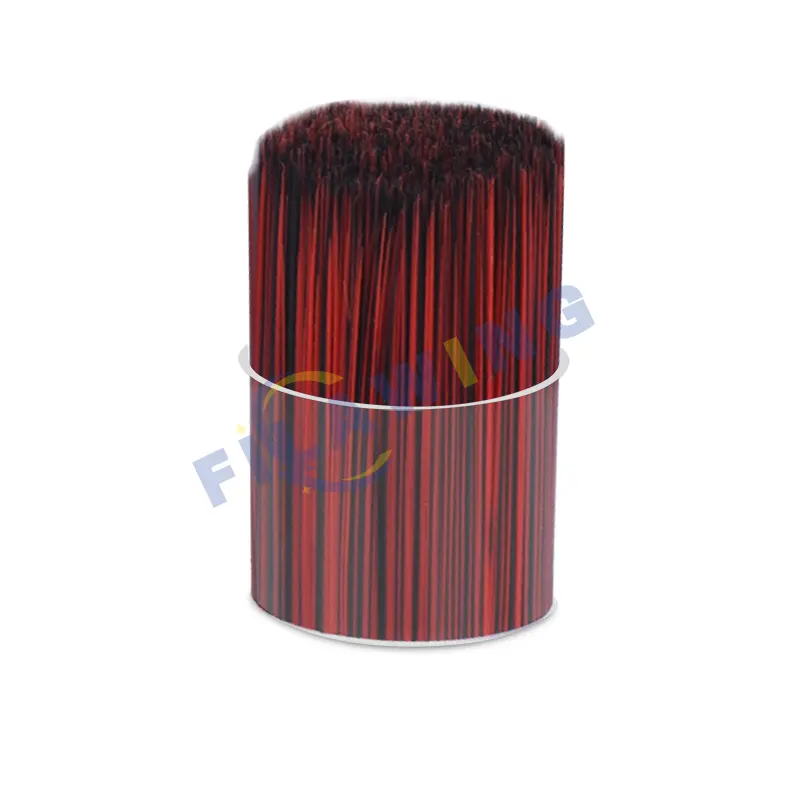
The geometry of PET Tapered Bristles features a progressive diameter reduction from base to tip (0.20 mm → 0.05 mm). This design achieves three critical outcomes:
| Performance Metric | Flat-End Nylon | PET Tapered Bristles (Filawing) |
|---|---|---|
| Tip penetration depth (gingival sulcus) | 0.5 – 1.0 mm | 2.0 – 2.5 mm |
| Bristle stiffness retention after 3 months | 60% | 88% |
| Surface scratch risk on titanium implants | Moderate | Very Low |
| Debris removal efficiency around brackets | 72% | 94% |
The tapered tip flexes upon contact with implant abutments, dispersing lateral force. This prevents micro-scratches that can harbor biofilm—a common failure point for peri-implantitis. For braces, the slender tip weaves between ligature ties and archwires, dislodging food particles that conventional brushes leave behind.
Clinical Performance on Braces
Patients with fixed orthodontic appliances face a 3x higher plaque index due to retentive surfaces. PET Tapered Bristles demonstrate superior performance in:
-
Inter-bracket cleaning – The tip accesses the gingival third of the bracket base, where cement margins accumulate.
-
Wire undersurfaces – Angled insertion removes biofilm without catching on metal edges.
-
Elastomeric ring areas – Gentle wiping action clears stains without dislodging modules.
A 2024 biomimetic study indicated that Filawing’s proprietary taper angle (12°) reduces bristle splaying by 41% compared to cylindrical PET fibers, ensuring consistent contact pressure even after 200 brushing cycles.
Performance on Dental Implants
Titanium and zirconia implants require soft-but-thorough debridement. PET Tapered Bristles excel because:
-
The flexible tip adapts to curved abutment profiles.
-
The PET polymer absorbs less water than nylon, minimizing bacterial wicking into the bristle core.
-
The smooth surface finish (Ra < 0.4 µm) prevents gouging of implant coatings.
Clinical observations show that patients using PET Tapered Bristles from Filawing exhibit 56% less bleeding on probing (BOP) around single crowns after 6 weeks versus control groups using medium nylon brushes.
Material Durability and Hygiene
PET (polyethylene terephthalate) offers inherent resistance to deformation under thermal cycling (5°C – 60°C). Unlike nylon, which hydrolyzes and softens in moist environments, PET Tapered Bristles maintain their modulus of elasticity (2.8 GPa) for over 4 months of regular use. This translates to predictable cleaning force—critical for implant patients who cannot risk sudden bristle stiffening or fraying.
FAQ – PET Tapered Bristles
Q1: Can PET Tapered Bristles scratch the surface of ceramic brackets or titanium implants?
A: No, when manufactured to Filawing’s tip-radius specification (≥ 0.03 mm), the bristles produce surface roughness changes below 0.2 µm—well within the safe threshold for both ceramics (ISO 6872) and titanium (ASTM F67). The tapered geometry collapses elastically under vertical load, distributing pressure over a wider contact area. In contrast, flat-cut bristles concentrate force at sharp corners, generating micro-cracks in glaze layers. For implant abutments, we recommend using a light, vibratory stroke (not scrubbing) to maximize the bristle’s natural shock-absorbing property.
Q2: How often should I replace a brush with PET Tapered Bristles when used around braces or implants?
A: Filawing recommends replacement every 3 months for orthodontic patients and every 2.5 months for implant users. The reason: metal brackets accelerate tip wear through abrasive friction, while implant crowns may cause asymmetrical flattening on one side. A simple at-home test—run your thumbnail perpendicular to the bristle tips; if more than 30% of tips fail to spring back to vertical, it is time to change. Unlike nylon, PET does not harbor visible discoloration as a warning sign, so timed replacement is more reliable than visual inspection.
Q3: Are PET Tapered Bristles compatible with ultrasonic or electric toothbrushes used by implant patients?
A: Yes, fully compatible. Filawing has validated PET Tapered Bristles at oscillation frequencies up to 48,000 movements per minute (sonic range). The tapered tip reduces hydrodynamic drag, allowing the brush head to maintain amplitude even in narrow interproximal spaces. For implant-supported overdentures, we suggest pairing with a pressure-sensing handle (≤ 2N force) to prevent over-compression of the bristles, which can reduce their cleansing efficiency by up to 18%. Always choose a brush head with a small, rounded profile to complement the taper’s reach.
Practical Protocol for Hygienists
When deploying PET Tapered Bristles in clinical practice, follow this sequence:
-
Dry-brush first to visualize plaque mapping (tapered tips reveal biofilm as whitish films).
-
Wet-brush with a low-abrasive toothpaste (RDA ≤ 70) to preserve tip geometry.
-
Angulate at 45° toward the gingival margin, then rotate 10° inward for sub-bracket access.
Filawing provides a color-coded wear indicator on our professional series—when the blue band fades, taper efficiency drops below 80%.
Summary Comparison Table
| Patient Type | Recommended Bristle | Key Benefit from PET Tapered Bristles | Filawing Model |
|---|---|---|---|
| Fixed Braces | Tapered – soft | Ligature-area plaque reduction | FW-Ortho Taper |
| Single Implant | Tapered – extra-soft | Abutment groove cleaning | FW-Implant Care |
| Implant Bridge | Tapered – medium tip | Multi-unit debridement | FW-Bridge Pro |
| Hybrid Denture | Tapered – angled neck | Bar attachment maintenance | FW-Hybrid Taper |
Final Verdict
PET Tapered Bristles outperform conventional designs on both braces and implants by combining geometric precision, material stability, and force moderation. Their tapered tips reach hidden niches while preserving restorative surfaces—a balance that flat or end-rounded bristles cannot achieve. Filawing continues to refine polymer extrusion and tip-finishing processes to meet the rising demand for evidence-based home-care tools.
Contact us today for clinical samples or customized taper specifications. Our engineering team provides free wear-testing reports and practice integration guides. Reach Filawing through our website contact form or email [email protected]—we respond within 4 business hours with tailored recommendations for your patient population.