

How Does a Brick Curing Room Improve Brick Quality and Production Efficiency?
2026-09-28
In modern concrete brick and block manufacturing, forming a brick is only the beginning. The curing stage has a direct influence on strength, durability, dimensional stability, and production consistency. A properly designed Brick Curing Room provides a controlled environment in which freshly formed bricks can develop their required properties while reducing the impact of changing outdoor conditions. For manufacturers seeking stable output and efficient production, the curing process has therefore become an important part of the complete brick-making system. QUANGONG MACHINERY CO.,LTD provides brick-making solutions and auxiliary equipment designed around the requirements of modern concrete block and brick production.
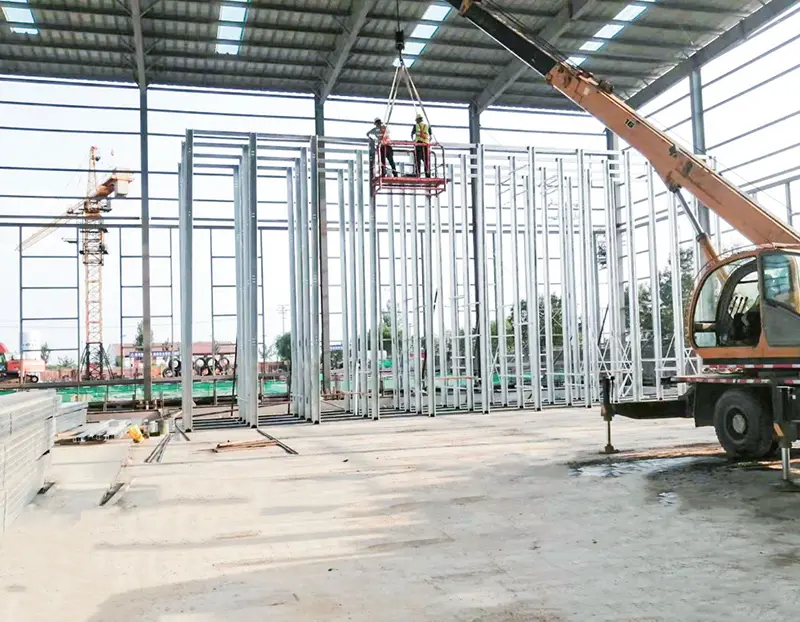
What Is a Brick Curing Room?
A Brick Curing Room is a dedicated space used to cure freshly molded concrete bricks, blocks, pavers, and other cement-based products. Instead of exposing newly formed products directly to uncontrolled environmental conditions, the curing room helps maintain suitable temperature and humidity conditions during the early curing period.
During curing, cement continues to hydrate and the internal structure of the product gradually develops. If moisture is lost too quickly, the surface may dry prematurely, increasing the risk of cracking, deformation, or inconsistent strength. A controlled curing environment helps create more stable curing conditions and supports more uniform product performance.
For automated brick production lines, the curing room can also be integrated with curing racks, material transfer equipment, and other auxiliary systems to create a smoother production flow.
Why Is a Brick Curing Room Important?
The value of a Brick Curing Room goes beyond simply providing storage space. Its main purpose is to make curing conditions more predictable.
Key benefits include:
-
More consistent strength: Controlled curing supports more uniform cement hydration and strength development.
-
Better dimensional stability: Proper moisture and temperature management can help reduce excessive shrinkage and deformation.
-
Lower cracking risk: Preventing overly rapid moisture loss helps protect freshly molded products.
-
Improved production consistency: Similar curing conditions from batch to batch make product quality easier to control.
-
Better space utilization: Organized curing racks can make more efficient use of factory space.
-
Higher production efficiency: A dedicated curing area can be incorporated into an automated production workflow.
These advantages are particularly valuable for manufacturers producing large quantities of concrete bricks and blocks, where small variations in individual products can become significant quality issues across an entire production batch.
How Does the Curing Process Improve Brick Performance?
After molding, concrete bricks contain cement, aggregates, water, and other materials. The cement hydration process continues after the brick leaves the molding machine. Maintaining suitable curing conditions gives this process a more controlled environment.
A typical process can be organized as follows:
1. Molding
Raw materials are mixed and compressed into the required brick or block shape.
2. Initial handling
Fresh products are carefully transferred to pallets or curing racks to avoid deformation.
3. Controlled curing
The products remain inside the Brick Curing Room, where environmental conditions are managed according to the production process.
4. Strength development
The cementitious material continues to hydrate and the internal structure becomes progressively stronger.
5. Final handling
After reaching the required curing condition, products can be transferred for inspection, stacking, packaging, or delivery.
This sequence allows curing to become a planned production stage rather than an uncontrolled waiting period.
Brick Curing Room vs. Outdoor Curing
| Factor | Brick Curing Room | Outdoor Curing |
|---|---|---|
| Temperature control | More controllable | Strongly affected by weather |
| Humidity management | More consistent | Variable |
| Product consistency | Generally higher | Can vary with conditions |
| Space utilization | Organized curing area | Requires larger open areas |
| Weather impact | Reduced | High |
| Production planning | Easier to standardize | More difficult |
Outdoor curing may be practical for certain production environments, but it can be affected by temperature changes, dry air, rain, wind, and seasonal conditions. A dedicated Brick Curing Room provides manufacturers with greater control over the curing environment and can make production planning more predictable.
What Production Effects Can Manufacturers Expect?
The most important effect is quality consistency. When bricks receive comparable curing conditions, manufacturers can reduce variations between production batches.
For high-volume factories, this can influence several aspects of daily operation:
-
More predictable product quality
-
Reduced risk of premature drying
-
Better use of factory space
-
Smoother material movement
-
More organized production scheduling
-
Easier integration with automated equipment
A curing system should therefore be considered as part of the complete production line rather than an isolated facility.
How Can QUANGONG MACHINERY Support Brick Production?
QUANGONG MACHINERY CO.,LTD, founded in 1979, specializes in the research, development, manufacturing, and sales of concrete block and brick-making machinery. Its product range covers automatic concrete block machines, brick-making machines, complete production lines, molds, and auxiliary equipment.
The company's solutions include Brick Machine Curing Room equipment and curing-related systems designed to work with modern brick production lines. QGM also provides technology upgrading, technical consulting, training, and other services for customers in the concrete block and brick manufacturing industry.
For manufacturers, the practical value lies in coordinating the molding, conveying, curing, and handling stages. QUANGONG MACHINERY's recent production-line solutions demonstrate an integrated approach in which mixing, conveying, molding, curing, and palletizing can form part of one automated manufacturing system.
Key Factors When Selecting a Brick Curing Room
Before selecting a system, manufacturers should consider:
-
Production capacity – The curing area should match the expected daily output.
-
Factory layout – Rack arrangement and material flow should support efficient loading and unloading.
-
Brick specifications – Different products may require different curing conditions and handling arrangements.
-
Environmental conditions – Local climate can influence the required curing strategy.
-
Automation level – Automated transfer and handling can reduce manual operations.
-
Future expansion – The curing system should ideally accommodate potential production increases.
A well-matched curing solution can help manufacturers balance product quality, factory space, labor requirements, and production efficiency.
Conclusion
A Brick Curing Room is an important component of modern concrete brick and block manufacturing. By creating a more controlled curing environment, it helps support consistent strength, dimensional stability, durability, and overall product quality. It can also improve production organization and integrate with automated material-handling systems.
For manufacturers looking to upgrade their brick production capabilities, the curing stage should receive the same attention as molding and material preparation. With extensive experience in concrete block and brick-making machinery, QUANGONG MACHINERY CO.,LTD can provide equipment and integrated solutions tailored to different production requirements.
If you are planning a new brick production line, upgrading an existing factory, or looking for a suitable Brick Curing Room solution, contact us to discuss your production capacity, brick specifications, factory layout, and automation requirements.