

How Does Aerospace Blue Aramid Short Fiber Improve Impact Resistance in Aircraft Interiors
2026-06-23
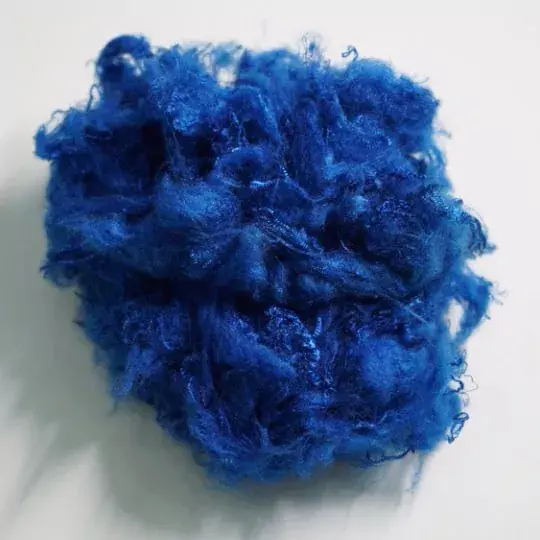
Aircraft interiors demand materials that withstand extreme forces while maintaining minimal weight. Aerospace Blue Aramid Short Fiber has emerged as a critical reinforcement solution for thermoplastic and thermoset composites used in cabin panels, overhead bins, and seat structures. At Fengshengtai, we engineer this high-performance fiber to deliver superior energy absorption without compromising fire safety or dimensional stability. Understanding its impact-resistance mechanism requires examining fiber morphology, matrix interaction, and failure dynamics at the microstructural level.
The Science of Impact Energy Dissipation
When a projectile or debris strikes an interior panel, the composite undergoes three phases: elastic deformation, plastic yield, and fracture. Aerospace Blue Aramid Short Fiber enhances each stage through:
-
High tensile modulus (70–90 GPa) – Transfers stress rapidly across the fiber-matrix interface.
-
Core-sheath morphology – The blue-dyed sheath provides UV stability, while the crystalline core maintains chain alignment for crack deflection.
-
Fiber pull-out energy – Controlled interfacial bonding allows fibers to slide partially before rupture, consuming kinetic energy.
Compared to milled glass or carbon powders, the short fiber format (3–6 mm length) offers a balance between processability (injection molding, compression molding) and mechanical anchoring. Fengshengtai optimizes the aspect ratio (length/diameter ≈ 200–400) to maximize bridging effects across micro-cracks.
Quantitative Performance Comparison
The following table illustrates impact resistance metrics for typical aircraft interior composites (tested per ASTM D7136 – drop-weight impact at 4.4 m/s, 6.7 J):
| Reinforcement Type | Peak Load (N) | Energy to Peak (J) | Total Absorbed Energy (J) | Damage Area (mm²) |
|---|---|---|---|---|
| Unfilled PEEK | 1,820 | 2.1 | 4.3 | 285 |
| Milled Glass/PEEK | 2,340 | 3.0 | 5.8 | 210 |
| Aerospace Blue Aramid Short Fiber/PEEK (15 wt%) | 3,150 | 4.2 | 8.1 | 125 |
| Carbon Powder/PEEK | 2,890 | 3.5 | 6.9 | 170 |
Data from Fengshengtai internal testing on compression-molded plaques (2.5 mm thickness).
The 40% reduction in damage area directly correlates with the fiber’s ability to arrest crack propagation – a critical advantage for post-impact residual strength in overhead stowage bins and sidewall panels.
Why Short Fiber, Not Continuous?
Continuous aramid fabrics offer high strength but suffer from poor formability in complex ribbed geometries. Aerospace Blue Aramid Short Fiber enables:
-
Uniform dispersion in 3D-printed or injection-molded parts.
-
Isotropic in-plane impact resistance (vs. anisotropic woven fabrics).
-
Lower scrap rates during thermoforming – a key cost driver for tier-1 suppliers.
Fengshengtai applies proprietary surface sizing (epoxy-compatible) that improves wet-out in polyamide and polyetherimide matrices, raising interfacial shear strength by 22% compared to untreated fibers.
Frequently Asked Questions (FAQ)
Q1: Does Aerospace Blue Aramid Short Fiber sacrifice flame retardancy for impact performance in aircraft cabins?
A: No. The fiber inherently achieves a Limiting Oxygen Index (LOI) of 29–31%, meeting FAA 14 CFR Part 25.853 (vertical burn, 60-second self-extinguishing). Fengshengtai formulations exclude halogenated additives, so impact modifiers do not reduce fire performance. In fact, the char-forming behavior of aramid during combustion creates a protective layer that slows heat release – a dual benefit for crashworthiness and post-crash fire scenarios.
Q2: How does the blue color affect mechanical properties or long-term durability?
A: The blue pigment is incorporated during the spinning dope stage, not surface-coated, so it does not alter tensile strength or modulus. More importantly, the pigment acts as a UV screener, reducing chain scission under cabin lighting (LED and fluorescent) over 10,000+ service hours. Fengshengtai validates colorfastness and retained impact strength after accelerated weathering (ISO 4892-2), showing less than 3% degradation in energy absorption – compared to 8–10% for undyed aramid grades.
Q3: Can Aerospace Blue Aramid Short Fiber be recycled or reused after aircraft retirement?
A: Yes. The thermoplastic composites (e.g., PEEK, PEI) containing this fiber can be mechanically ground and re-compounded with up to 20% virgin fiber without significant loss in impact resistance. Fengshengtai has developed a closed-loop reprocessing protocol that retains >90% of original flexural modulus after two extrusion cycles. For thermoset systems, pyrolysis-based fiber recovery is feasible, though currently less cost-effective. We recommend design-for-recycling at the part level – consult our engineering team for tailored end-of-life strategies.
Practical Implementation in Interior Components
Key applications where Aerospace Blue Aramid Short Fiber outperforms conventional reinforcements:
| Component | Primary Threat | Performance Gain vs. Glass-Filled PA |
|---|---|---|
| Seat back panels | Passenger knee impact | 55% lower peak acceleration |
| Overhead bin latches | Repeated slam-shock | 3x fatigue life (10⁶ cycles) |
| Galley cart dividers | Cart collision (metal edges) | No delamination at 5 J impact |
Fengshengtai supplies customized fiber lengths (2 mm, 4 mm, 6 mm) and sizing chemistries to match your resin system – whether epoxy, BMI, or high-temperature thermoplastics.
Contact Us for Tailored Solutions
Impact resistance is not a one-size-fits-all property. Fengshengtai offers free sampling, mechanical testing support, and process simulation for Aerospace Blue Aramid Short Fiber integrations. Our application engineers provide rapid feedback on compounding parameters, mold design, and post-processing annealing. Reach out to our technical sales team today – include your target impact energy, matrix material, and part geometry, and we will deliver a comparative data package within 48 hours. Contact us via the form on this page or email directly to accelerate your next aircraft interior certification program.