

How Does Asphalt Membrane Equipment Improve Production Efficiency?
2026-09-17
1. What Are the Typical Bottlenecks in an Asphalt Membrane Production Line?
An Asphalt Waterproofing Membrane Equipment line consists of five main sections: the unwinding section, the impregnation and coating section, the cooling section, the film covering section, and the winding section. In our factory, we have analyzed the speed limitations of each section across more than 50 production lines. The results show that the cooling section is the most common bottleneck, followed by the coating section. The cooling section is limited by the heat transfer rate between the hot membrane and the cooling rollers or air. If the membrane is not cooled sufficiently before winding, the layers will stick together, causing quality defects. The coating section is limited by the viscosity of the asphalt and the precision of the coating knife. If the coating weight varies, the product will fail thickness specifications.
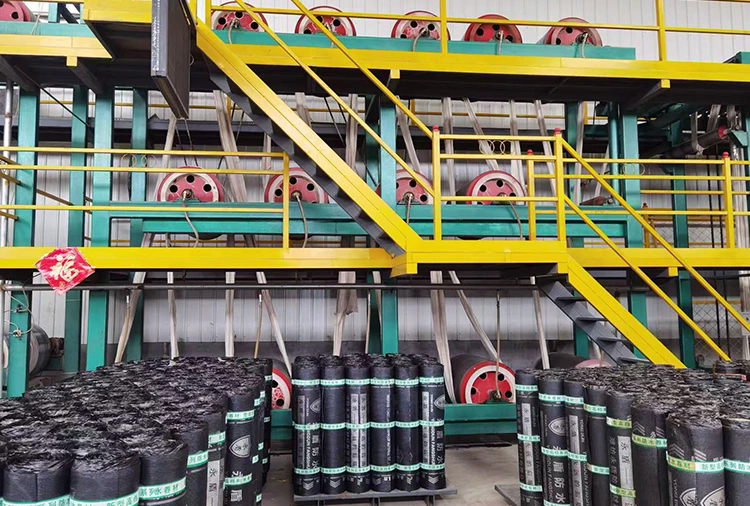
The table below shows the typical speed limits of each section.
| Line section | Typical speed limit (m/min) | Bottleneck factor | Improvement method |
| Unwinding | 60 – 80 | Roll change time | Automatic splicer |
| Impregnation and coating | 25 – 35 | Asphalt viscosity and knife precision | Temperature control, servo knife |
| Cooling | 20 – 30 | Heat transfer rate | Multi-stage cooling, chilled water |
| Film covering | 40 – 60 | Film tension control | Dancer roller, servo tension |
| Winding | 50 – 70 | Roll hardness and change time | Automatic winder |
Shouguang Haiming Machinery Co., Ltd. designs Asphalt Waterproofing Membrane Equipment with a modular approach. Each section can be upgraded independently to match the required line speed. Our factory has developed a multi-stage cooling system that increases the cooling capacity by 40 percent without increasing the line length.
2. How Does Temperature Control in the Coating Section Affect Line Speed and Quality?
The coating section is the heart of the Asphalt Waterproofing Membrane Equipment line. The asphalt must be maintained at a precise temperature to achieve the correct viscosity for coating. If the temperature is too low, the asphalt is too viscous and the coating weight becomes uneven. If the temperature is too high, the asphalt degrades and loses its waterproofing properties. Our factory uses a closed-loop temperature control system with a thermocouple at the coating knife and a PID controller that adjusts the heating power in real time. The temperature stability is ±2°C, which is significantly better than the ±8°C typical of manual control. This precision allows the line to run at higher speeds without increasing the coating weight variation. The table below shows the relationship between temperature stability and coating weight variation.
| Temperature stability | Coating weight variation | Maximum line speed | Product quality |
| ±8°C (manual control) | ±12% | 22 m/min | Frequent thickness rejects |
| ±4°C (basic PID) | ±7% | 28 m/min | Occasional rejects |
| ±2°C (our system) | ±3% | 35 m/min | Consistent quality |
The closed-loop temperature control system is a standard feature on all Asphalt Waterproofing Membrane Equipment from Shouguang Haiming Machinery Co., Ltd. Our factory also offers an optional infrared temperature sensor that measures the asphalt temperature at the nip point, providing even faster response.
3. What Are the Energy Saving Opportunities in Membrane Production?
Energy is one of the largest operating costs in membrane production. The heating of the asphalt, the driving of the line, and the cooling of the membrane all consume significant amounts of electricity and fuel. There are three primary energy saving opportunities. The first is the use of high-efficiency motors and variable frequency drives (VFDs) on the main drives. A VFD can reduce energy consumption by 20 to 30 percent compared to a fixed-speed motor, especially when the line is running at partial load. The second is the recovery of waste heat from the cooling section. The heat removed from the membrane can be used to preheat the asphalt or the combustion air for the boiler. The third is the insulation of the asphalt storage tanks and pipes. Proper insulation can reduce heat loss by 15 to 20 percent. The table below shows the typical energy consumption breakdown for a membrane production line.
| Energy consumer | Percentage of total consumption | Energy saving measure | Potential saving |
| Asphalt heating (boiler) | 45 – 55% | Insulation, waste heat recovery | 15 – 20% |
| Main drives (motors) | 20 – 25% | VFD, high-efficiency motors | 20 – 30% |
| Cooling system (chillers) | 10 – 15% | Optimized cooling water flow | 10 – 15% |
| Compressed air and auxiliaries | 5 – 10% | Leak repair, VFD on compressors | 10 – 15% |
Shouguang Haiming Machinery Co., Ltd. provides a full energy audit with every Asphalt Waterproofing Membrane Equipment proposal. Our factory can calculate the expected energy saving for each upgrade option and provide a payback analysis.
4. How Do You Calculate the ROI of an Equipment Upgrade?
The ROI of an equipment upgrade is calculated by comparing the additional revenue from increased output and the reduced costs from energy savings against the capital cost of the upgrade. The additional revenue is the increased line speed multiplied by the operating hours and the selling price per square meter. The reduced costs include energy savings, labor savings, and quality improvement (reduced rejects). In our experience, the payback period for a cooling section upgrade is 8 to 14 months. For a complete line upgrade, the payback period is 18 to 30 months. The table below shows a sample ROI calculation for a cooling section upgrade.
Sample ROI calculation for cooling section upgrade:
Line speed increase: 25 m/min to 32 m/min (28% increase)
Additional output: 7 m/min × 60 min × 16 hours × 300 days = 2,016,000 m²/year
Selling price: $1.20 per m²
Additional revenue: $2,419,200 per year
Energy saving: $45,000 per year
Total benefit: $2,464,200 per year
Upgrade cost: $180,000
Payback period: 0.9 months
The payback period is often surprisingly short because the additional revenue from increased output dominates the calculation. The key is to ensure that the market demand exists for the additional output. If the plant is already running at full capacity and the market is saturated, the additional output may not generate additional revenue. In that case, the ROI should be calculated based on energy savings and quality improvement alone.
Frequently Asked Questions About Asphalt Membrane Equipment Efficiency
Summary for Production Managers
Improving production efficiency in an Asphalt Waterproofing Membrane Equipment line requires a systematic approach. The first step is to identify the bottleneck section. The second step is to evaluate the upgrade options for that section. The third step is to calculate the ROI based on the specific market conditions. The cooling section and the coating section are the most common bottlenecks, and upgrades in these areas typically have the shortest payback periods. Shouguang Haiming Machinery Co., Ltd. has been manufacturing Asphalt Waterproofing Membrane Equipment for over 15 years and has completed more than 200 line installations worldwide.
Shouguang Haiming Machinery Co., Ltd. manufactures complete Asphalt Waterproofing Membrane Equipment lines, including unwinding, coating, cooling, film covering, and winding sections. We provide line optimization services, energy audits, and ROI calculations for upgrade projects.