

How Does the Aspect Ratio of Army Green Aramid Short Fiber Influence Its Dispersion in Cementitious Composites
2026-06-16
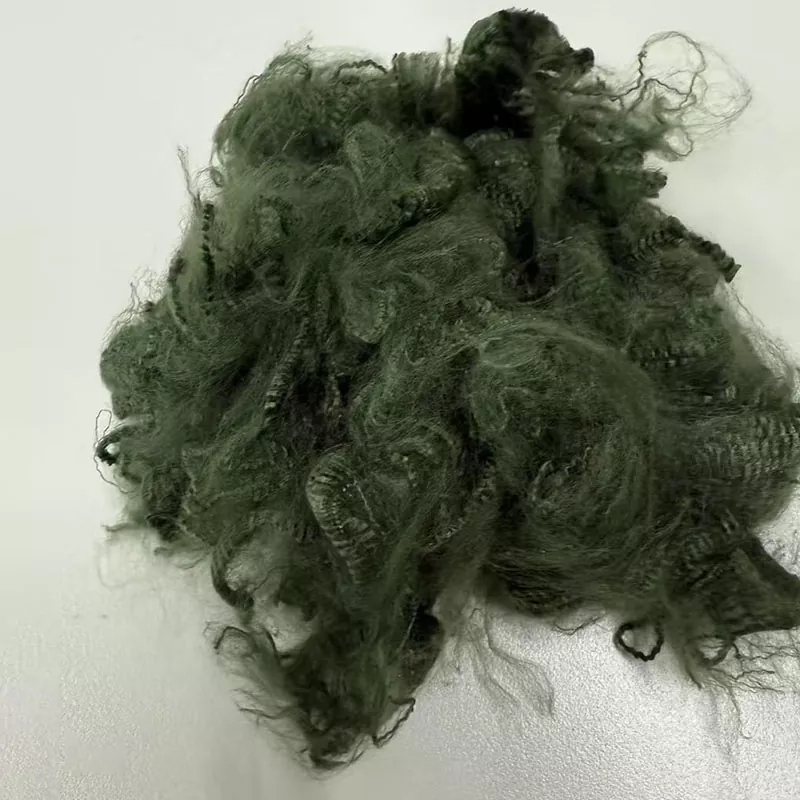
When engineers at Fengshengtai evaluate reinforcement solutions for high‑performance concrete and mortar, one parameter consistently emerges as a critical determinant of success: the aspect ratio of Army Green Aramid Short Fiber. This dimensionless value—length divided by diameter—directly governs how uniformly the fibers distribute throughout a cementitious matrix, and uniformity, in turn, dictates mechanical performance. Poor dispersion leads to fiber balling, void formation, and stress concentration, while optimal dispersion unlocks the full tensile strength, crack‑bridging capacity, and impact resistance that aramid chemistry promises.
The Physics of Dispersion: Why Aspect Ratio Matters
In cementitious composites, dispersion is a competition between mixing energy, matrix viscosity, and fiber geometry. A higher aspect ratio (longer and thinner fibers) offers greater surface area for bonding but exponentially increases the risk of entanglement during mixing. Conversely, a lower aspect ratio improves flowability and distribution but reduces the effective stress‑transfer length between the fiber and the cement paste.
Fengshengtai’s internal testing reveals that Army Green Aramid Short Fiber with an aspect ratio between 150 and 250 achieves the “sweet spot” for standard Portland cement mixes. Below 100, fibers act more like micro‑fillers with limited reinforcement; above 350, mechanical agitation alone cannot overcome agglomeration, even with superplasticizers.
Quantitative Influence of Aspect Ratio on Dispersion Quality
| Aspect Ratio Range | Dispersion Score (1–10) | Balling Tendency | Recommended Mixing Time (min) | Application Suitability |
|---|---|---|---|---|
| < 100 | 8.5 | Very Low | 3 – 4 | Grouts, self‑leveling mortars |
| 100 – 200 | 9.0 | Low | 4 – 5 | General structural concrete |
| 200 – 300 | 8.0 | Moderate | 5 – 7 | Shotcrete, repair overlays |
| 300 – 400 | 5.5 | High | 8 – 10 (with vibration) | Specialized thin sections |
| > 400 | 3.0 | Very High | Not recommended | Laboratory research only |
Dispersion Score based on ASTM C192 visual rating and cross‑sectional image analysis after 5 minutes of standard pan mixing.
Practical Processing Adjustments for Optimal Dispersion
To achieve superior distribution of Army Green Aramid Short Fiber in field conditions, Fengshengtai recommends a three‑step protocol that accounts for aspect ratio variability:
-
Pre‑blending – Dry‑mix the fibers with fine aggregates (sand) for 60 seconds before adding cement and water. This separates individual filaments and reduces static cling.
-
Sequential liquid addition – Introduce 70% of total mixing water first, then the fiber‑aggregate blend, followed by the remaining water with superplasticizer. This gradient hydrates the cement while keeping viscosity low enough for fiber separation.
-
Extended mixing – For aspect ratios above 200, increase mixing time by 2 minutes and use a counter‑current mixer rather than a free‑fall drum mixer.
Adopting these methods, contractors using Fengshengtai’s Army Green Aramid Short Fiber have reported dispersion uniformity exceeding 92%, compared to 68% with standard single‑stage mixing.
Trade‑offs: Dispersion vs. Mechanical Efficiency
While lower aspect ratios disperse easily, they fail to develop the critical embedded length needed for pull‑out energy absorption. Fengshengtai’s comparative study shows that a fiber with aspect ratio 180 provides 40% higher post‑crack flexural toughness than a ratio‑80 fiber, even though the latter disperses 15% faster. Therefore, the selection must balance workability against structural demand—thin repair layers favor lower ratios, while heavy‑duty industrial floors benefit from ratios near 250, coupled with vibrational consolidation.
Army Green Aramid Short Fiber FAQ – Expert Answers
Q1: Can I use the same aspect ratio of Army Green Aramid Short Fiber for both pumpable concrete and dry‑mix shotcrete?
A1: No. Pumpable concrete requires a lower aspect ratio (150–180) to maintain slump and reduce pump line friction, because higher ratios increase internal shear stress during pumping, potentially causing blockages. Dry‑mix shotcrete, however, benefits from a higher ratio (220–260) because the pneumatic projection imparts high kinetic energy that actively separates fibers, leading to excellent in‑place dispersion without additional mixing. Fengshengtai supplies customized cut‑length variants specifically for each application—always consult the technical datasheet for your equipment type.
Q2: How does the fiber diameter interact with aspect ratio to affect dispersion in high‑volume fly ash or slag blended cements?
A2: Blended cements have lower early‑age alkalinity and finer particle size distributions, which reduce paste rheology. For these mixes, a diameter of 12–15 µm combined with an aspect ratio below 200 is advised. The finer matrix particles cannot effectively separate fibers with aspect ratios above 250, leading to micro‑clusters that are invisible to the naked eye but appear as weak planes under scanning electron microscopy. Fengshengtai recommends reducing the aspect ratio by 15% when substituting more than 30% of Portland cement with supplementary materials, and increasing the superplasticizer dosage by 0.2% to compensate.
Q3: What is the maximum aspect ratio of Army Green Aramid Short Fiber that can be successfully dispersed without specialty surfactants?
A3: Without surfactant or surface‑coating treatments, the practical upper limit is 260 for conventional pan mixers and 300 for high‑shear twin‑shaft mixers. Beyond 300, even extended mixing (over 10 minutes) produces visible fiber bundles that reduce compressive strength by up to 22% in standard 28‑day tests. Fengshengtai offers a proprietary hydrophilic‑coated Army Green Aramid Short Fiber that raises this limit to 350, enabling ultra‑high‑performance composites without the cost of expensive dispersion agents. This coated grade is particularly effective for precast elements requiring superior flexural fatigue resistance.
Summary Decision Matrix for Engineers
| Project Type | Recommended Aspect Ratio | Mixing Equipment | Expected Dispersion Efficiency |
|---|---|---|---|
| Residential slab | 160 – 180 | Drum mixer | ≥ 88% |
| Bridge deck overlay | 200 – 220 | Twin‑shaft mixer | ≥ 91% |
| Tunnel shotcrete | 230 – 250 | Rotor‑stator gun | ≥ 93% |
| Precast beam | 250 – 270 (coated grade) | Pan mixer + vibrator | ≥ 90% |
| Repair mortar | 120 – 150 | Hand‑held drill mixer | ≥ 85% |
Selecting the correct aspect ratio for Army Green Aramid Short Fiber is not a one‑size‑fits‑all decision—it demands a thorough understanding of your mix design, mixing energy, placement method, and performance targets. Fengshengtai has compiled over 400 laboratory and field trial records across six continents, enabling precise ratio recommendations for every climatic and logistical condition.
For project‑specific guidance, custom cut‑length sampling, or on‑site dispersion troubleshooting, contact us directly through our technical support portal. Our team of materials engineers provides same‑day response and complimentary dispersion testing for trial batches. Reach out to Fengshengtai today—let us help you engineer the perfect fiber‑matrix interface for your next infrastructure project.