
How to Apply Woven Interlining Fabric Correctly with a Heat Press
2026-09-30
Achieving a crisp, professional finish in garment construction depends heavily on how well you bond your Woven Interlining Fabric. At Derusen, we have spent years refining heat press techniques for woven interlinings used in suits, coats, and structured garments. This guide shares the exact parameters and methods our technicians recommend for consistent, durable results.
Understanding the Bonding Window
Every Woven Interlining Fabric has a specific activation range determined by its resin coating. Exceeding this range causes strike-through, while falling short produces weak adhesion. The table below outlines typical settings for common Derusen woven interlining weights.
| Interlining Weight (gsm) | Temperature (°C) | Pressure (bar) | Dwell Time (sec) |
|---|---|---|---|
| 50–70 (light) | 130–140 | 2.0–2.5 | 8–10 |
| 80–110 (medium) | 140–150 | 2.5–3.0 | 10–12 |
| 120–160 (heavy) | 150–160 | 3.0–3.5 | 12–15 |
These values assume a fusible coating on a natural-fiber base cloth. Always verify with a test swatch before production.
Step-by-Step Application Process
-
Precondition the fabric. Relax both the shell fabric and the Woven Interlining Fabric for at least four hours in the production environment to equalize moisture content.
-
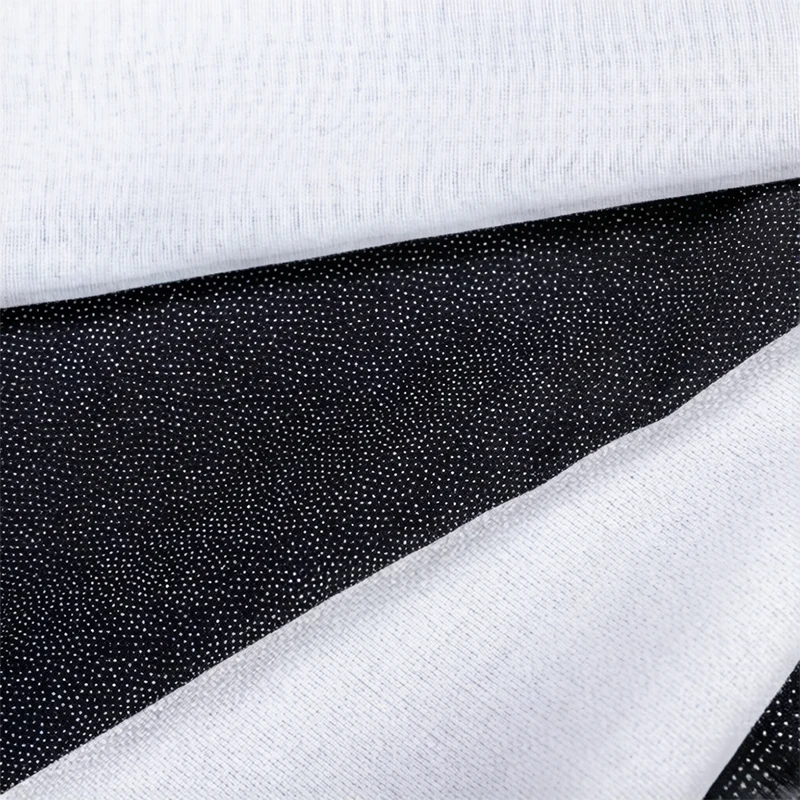
Align the resin side. The fusible dots must face the wrong side of the shell. On Derusen products, the coated side is slightly tacky and duller in appearance.
-
Position without tension. Lay the interlining flat. Any stretch introduced here becomes permanent distortion after cooling.
-
Apply heat and pressure. Use the settings from the table above. A single pass is preferred over multiple reheats.
-
Cool under weight. Let the bonded piece rest flat for 20–30 minutes before handling. This allows the resin to crystallize and reach full bond strength.
Critical Quality Checks
-
Peel test: After cooling, attempt to separate the layers. The bond should hold, and the resin should not transfer to the shell.
-
Surface inspection: Look for bubbles, strike-through, or shine. These indicate excessive temperature or pressure.
-
Dimensional stability: Measure before and after bonding. Derusen Woven Interlining Fabric is engineered to limit shrinkage to under 1%.
Common Mistakes to Avoid
| Mistake | Consequence | Correction |
|---|---|---|
| Insufficient dwell time | Weak bond, delamination | Increase time in 2-second increments |
| Over-pressing | Shine, handfeel loss | Lower temperature by 5–10°C |
| Moisture in fabric | Bubbles, steam pockets | Pre-dry at 60°C for 10 minutes |
| Uneven pressure | Patchy adhesion | Calibrate press before each batch |
Frequently Asked Questions
Can I use a home iron instead of a heat press for Woven Interlining Fabric?
A home iron lacks consistent temperature and pressure control, so it often produces uneven bonds. A heat press is strongly recommended for professional results with Woven Interlining Fabric.
How do I know which side of the Woven Interlining Fabric is fusible?
The fusible side carries a visible resin coating, usually in dot or paste form. It feels slightly rougher and appears duller than the base cloth side.
Does Woven Interlining Fabric work on synthetic shell fabrics?
Yes, but lower the temperature to 120–130°C to avoid melting the shell. Always test a small area first, especially with Derusen products designed for natural fibers.
Conclusion
Correct heat press application of Woven Interlining Fabric transforms a good garment into an exceptional one. By following the parameters and checks outlined above, you protect both the fabric and the final silhouette. For tailored solutions, technical data sheets, or bulk pricing on Derusen Woven Interlining Fabric, contact us today. Our team will help you select the right specification for your production line.