

What Are the Main Differences Between a Ceramic Crucible and a Graphite Crucible
2026-06-12
When selecting a Ceramic Crucible or a graphite crucible for high-temperature applications, understanding their core properties is essential. At Okayama Giken Minerals, we have engineered advanced Ceramic Crucible solutions that serve distinct industrial needs. This guide breaks down the key differences to help you make an informed choice.
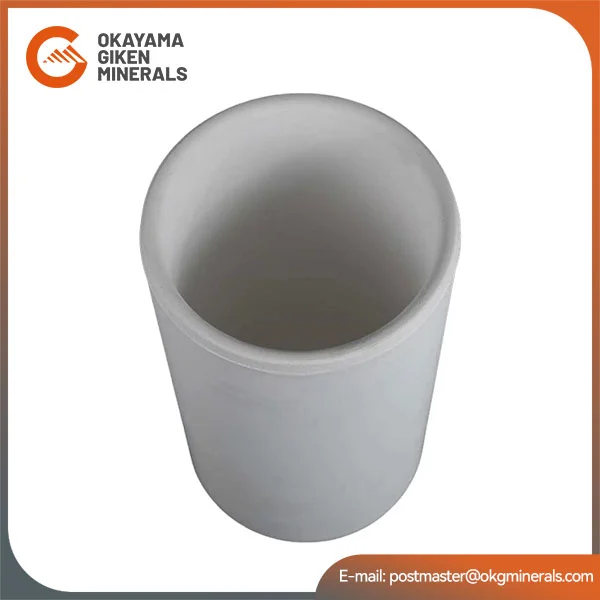
Material Composition and Structure
-
Ceramic Crucible: Made from inorganic, non-metallic materials like alumina, zirconia, or fused silica. Offers high hardness and chemical inertness.
-
Graphite Crucible: Composed of carbon atoms arranged in hexagonal layers. Provides natural lubricity and excellent thermal conductivity.
Key Differences at a Glance
| Feature | Ceramic Crucible | Graphite Crucible |
|---|---|---|
| Maximum service temperature | 1600°C – 1800°C (alumina) | Up to 3000°C (inert atmosphere) |
| Thermal shock resistance | Moderate to high (depends on formulation) | Very high |
| Chemical reactivity | Inert with most acids/bases | Reacts with oxygen and some molten metals |
| Electrical conductivity | Insulator | Conductor |
| Cost per use | Lower for short runs | Higher but reusable longer |
| Best for | Oxidizing environments, glass, ceramics | Vacuum furnaces, non-ferrous metals |
Performance in Real Applications
A Ceramic Crucible excels in oxidizing atmospheres where graphite would rapidly oxidize. For example, Okayama Giken Minerals produces Ceramic Crucible lines specifically for melting soda-lime glass and sintering technical ceramics. Graphite crucibles, while handling higher temperatures, require vacuum or reducing conditions to avoid burning.
Advantage of Ceramic: No carbon contamination of sensitive melts.
Advantage of Graphite: Faster heating cycles due to superior thermal diffusivity.
Ceramic Crucible FAQ – Common Questions from Professionals
Q1: Can a Ceramic Crucible be used for melting precious metals like gold or platinum?
A: Yes, but with careful selection. A high-purity alumina Ceramic Crucible is suitable for gold (1064°C) and silver. For platinum (1768°C), a zirconia or specially stabilized Ceramic Crucible is required to avoid metal-ceramic reactions. Unlike graphite, a Ceramic Crucible will not carburize precious metals, preserving purity. However, always check the crucible’s maximum operating temperature and avoid rapid quenching.
Q2: Why does my Ceramic Crucible sometimes crack after several heating cycles?
A: Thermal fatigue is the primary cause. Even a high-quality Ceramic Crucible undergoes micro-expansion each cycle. Common reasons include: uneven heating (e.g., placing a cold crucible directly into a hot furnace), exceeding the recommended ramp rate (above 5-10°C/min for large sizes), or using a Ceramic Crucible past its thermal cycle life. Okayama Giken Minerals recommends annealing a new Ceramic Crucible at 200°C for 2 hours before first use to relieve residual stresses.
Q3: How do I clean a Ceramic Crucible after melting borosilicate glass?
A: First, allow the Ceramic Crucible to cool slowly to room temperature – never water quench. Remove bulk glass mechanically using a non-metallic tool. Then prepare a 10% hydrofluoric acid solution (extreme caution – use PTFE container and full PPE) or safer alternative: a hot solution of sodium hydroxide (20% w/w) at 90°C for 30 minutes, followed by rinsing with distilled water. For stubborn residues, Okayama Giken Minerals offers a chemical cleaning service for our Ceramic Crucible users. Do not use steel brushes as they leave metal traces.
Which One Should You Choose?
-
Select a Ceramic Crucible when working with oxidizing conditions, glass, ceramics, or when electrical insulation is needed.
-
Select a graphite crucible for induction melting of aluminum, copper, or when ultra-high temperature (above 1800°C) is required in non-air environments.
Okayama Giken Minerals provides custom-engineered Ceramic Crucible shapes – from standard cylindrical to complex ladle forms – with documented thermal cycle life and chemical resistance tables.
For bulk orders, technical data sheets, or assistance selecting the right Ceramic Crucible for your exact melt chemistry, contact us today via our website or email [email protected]. Our engineers will respond within 24 hours with a detailed recommendation.