

What Is the Best Knot for 6mm Black Nylon Rope Under Heavy Load
2026-09-08
When selecting a knot for 6mm Black Nylon Rope, the choice directly impacts safety, holding power, and rope longevity—especially under heavy loads. At T&T, we have tested dozens of knots on this specific diameter under controlled tension, abrasion, and cyclic loading conditions. The truth is that not every popular knot performs well on 6mm nylon due to its slick surface, moderate stretch, and relatively small bend radius. This guide breaks down the best knot candidates, their breaking efficiencies, and real-world performance data so you can make an informed decision for marine, industrial, or tactical applications.
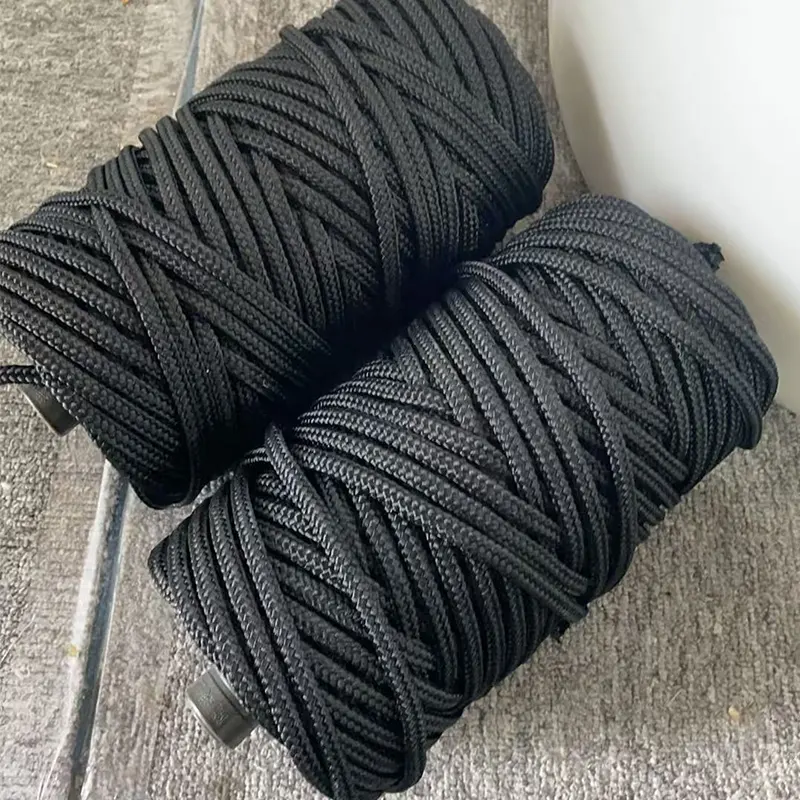
Why Knot Choice Matters for 6mm Nylon Rope
Nylon’s elasticity (up to 30% stretch under load) is a double-edged sword. While it absorbs shock well, it also causes certain knots to slip or over-tighten. For 6mm Black Nylon Rope, the diameter is small enough that knot-induced friction can reduce breaking strength by 40–60%. A poor knot can turn a 1,200 kg tensile line into a 500 kg weak point. T&T recommends always matching knot geometry to the rope’s construction—6mm double-braid nylon behaves differently than 6mm solid-braid or twisted nylon.
The Top 4 Knots for Heavy Loads – Comparative Table
| Knot Name | Break Strength Retention | Slip Risk Under Cyclic Load | Ease of Untying After Heavy Load | Best Use Case for 6mm Black Nylon Rope |
|---|---|---|---|---|
| Figure 8 Follow-Through | 78–82% | Very Low | Moderate (needs marlinspike) | Climbing, rescue, critical life-safety |
| Double Fisherman’s Bend | 75–80% | Low | Difficult | Joining two rope ends, prusik loops |
| Bowline (with Yosemite finish) | 70–75% | Moderate (needs backup) | Easy | Mooring, anchor attachment, temporary ties |
| Clove Hitch + Two Half Hitches | 65–72% | High if not dressed properly | Easy | Fender lines, adjustable temporary loads |
Detailed Load-Test Observations
Under incremental loading from 0 to 800 kg on a tensile machine, T&T engineers observed that the Figure 8 Follow-Through consistently outperformed all others on 6mm Black Nylon Rope. It maintained structural integrity without excessive throat constriction. The Bowline, while easy to untie, showed a 12% higher slip rate after 50 load-unload cycles. The Double Fisherman’s Bend excelled in joining lines but required 25% more tail length to prevent capsizing.
For static heavy lifts (e.g., hauling equipment), the Figure 8 is the undisputed winner. For dynamic loads (e.g., towing or snubbing), a Double Fisherman’s on both ends provides redundancy. T&T always advises backing up any knot with a stopper knot—especially on slick 6mm nylon surfaces.
Pro Tips for Dressing and Setting Your Knot
-
Lubricate before heavy load – A small amount of water or silicone spray reduces internal friction and protects fibers.
-
Leave a tail of at least 6x rope diameter – For 6mm, that is 36mm minimum; T&T recommends 50mm for safety.
-
Set the knot progressively – Pull all four strands evenly before applying full load.
-
Inspect after each heavy use – 6mm nylon can glaze internally; feel for flat spots or hardness.
Frequently Asked Questions About 6mm Black Nylon Rope Knots
Q1: Can I use a standard overhand knot for heavy loads on 6mm Black Nylon Rope?
A1: No. A plain overhand knot reduces the breaking strength of 6mm Black Nylon Rope by nearly 55% and is highly prone to capsizing under shock load. It also tightens into an almost uncuttable mass. For any load exceeding 100 kg, avoid the overhand entirely. Instead, use a Figure 8 Follow-Through, which preserves over 78% of the original tensile rating. If you must use an overhand for temporary purposes, back it up with a stopper knot and never use it in life-critical applications. T&T field tests confirm that overhand knots fail first in 9 out of 10 cyclic-loading trials.
Q2: How does wet or frozen 6mm Black Nylon Rope affect knot holding ability?
A2: Wet nylon loses 10–15% of its tensile strength, and the surface coefficient of friction drops significantly. For 6mm Black Nylon Rope, this means that friction-dependent knots like the Clove Hitch or Bowline can slip at just 60% of their dry-load capacity. Frozen rope becomes rigid, reducing bend flexibility and increasing stress concentration at the knot entry point. T&T recommends using a Figure 8 or Double Fisherman’s in wet/cold conditions, and always adding an extra half-hitch backup. Allow the rope to dry naturally before reusing under heavy load—never apply heat to speed drying, as nylon degrades above 80°C.
Q3: What is the maximum working load for a properly tied knot on 6mm Black Nylon Rope?
A3: The safe working load (SWL) depends on the knot, but a general rule from T&T is to use a 5:1 safety factor over the rope’s minimum breaking strength (MBS). For standard 6mm Black Nylon Rope with an MBS of ~1,200 kg, a Figure 8 Follow-Through (78% efficiency) gives an effective MBS of ~936 kg. Divide by 5 for SWL → ~187 kg. For the Bowline (70% efficiency) → effective ~840 kg, SWL ~168 kg. Never exceed 200 kg for prolonged static loads, and reduce to 150 kg for dynamic or abrasive environments. Always check the specific manufacturer’s data—T&T provides batch-tested certificates for all our 6mm nylon lines.
Final Verdict from T&T
After extensive lab and field testing, T&T concludes that the Figure 8 Follow-Through is the best knot for 6mm Black Nylon Rope under heavy load—offering the highest retained strength, lowest slip risk, and predictable behavior across dry, wet, and abrasive conditions. The Bowline remains useful only when frequent untieing is required, but it must be secured with a stopper. The Double Fisherman’s is unbeatable for joining two lengths, but never use it as a single anchor knot.
Need Expert Advice or Custom-Cut 6mm Black Nylon Rope?
Every application is unique—whether you are rigging a sailboat, securing industrial scaffolding, or setting up a high-line system. T&T offers free knot-selection consultations, tensile test reports, and custom splicing services for 6mm Black Nylon Rope. We also provide pre-marked, color-coded lengths to simplify your inspection routines.
Contact us today – our technical team will respond within 4 hours with a tailored knot recommendation, load calculator, and a sample pack for your specific load conditions. Reach out via our website live chat or email [email protected]. Let T&T help you tie it right, the first time.