

What Is the Difference Between Flexible and Rigid Electrical Insulation Crepe Paper Tube
2026-07-21
When selecting insulation materials for high-voltage transformers, motor windings, or coil terminations, engineers often face a critical choice between flexible and rigid variants of Electrical Insulation Crepe Paper Tube. This decision directly impacts assembly efficiency, thermal performance, and long-term reliability. At Hanyao, we have tested both configurations across thousands of real-world applications, and the differences run far deeper than simple bendability. Understanding these distinctions ensures you specify the right tube for your dielectric, mechanical, and environmental demands.
Mechanical Properties at a Glance
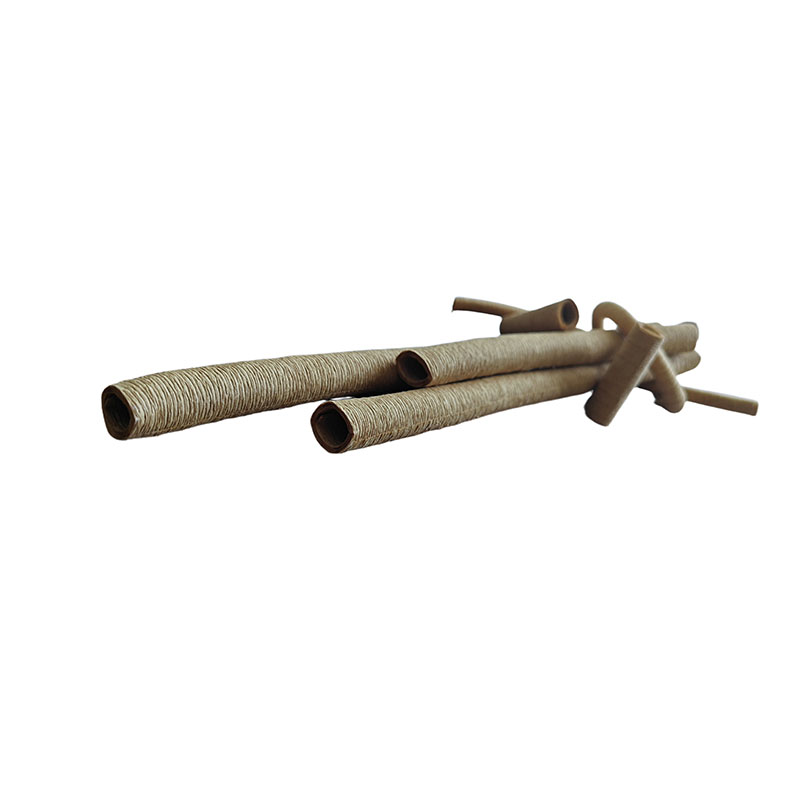
The core distinction lies in how each type responds to physical stress. A flexible Electrical Insulation Crepe Paper Tube uses a spiral-wound, creped substrate that allows compression and elongation, making it ideal for routes with multiple bends or vibration. A rigid Electrical Insulation Crepe Paper Tube, conversely, employs a straight-wall or heavily resin-bonded construction that maintains its cylindrical shape under load.
| Property | Flexible Type | Rigid Type |
|---|---|---|
| Bending radius | ≥ 1.5× outer diameter | ≥ 5× outer diameter (risk of cracking below) |
| Compression recovery | High (returns after clamping) | Low (permanent deformation possible) |
| Tensile strength | Moderate (crepe stretch absorbs stress) | High (straight fibers resist axial pull) |
| Vibration damping | Excellent (crepe layer absorbs micro-movements) | Poor (transmits vibration to conductors) |
| Cut-edge fraying | Minimal (crepe fibers interlock) | Moderate (requires clean shearing) |
| Dielectric stability under flex | Stable up to 1,000+ flex cycles | Degrades sharply after 200–300 cycles |
Thermal and Electrical Trade-Offs
Heat dissipation and dielectric strength often dictate the final choice. A flexible Electrical Insulation Crepe Paper Tube typically offers Class B (130°C) to Class F (155°C) ratings, with the crepe structure providing microscopic air gaps that enhance thermal wicking. However, those same gaps can reduce dielectric withstand voltage compared to a rigid counterpart. Hanyao’s rigid tubes achieve up to 8 kV/mm dielectric strength due to denser paper layering, whereas flexible versions average 5–6 kV/mm—still sufficient for most industrial motors but critical to note for 11 kV+ switchgear.
In high-temperature cycling (e.g., -40°C to +150°C), the flexible tube expands and contracts with conductors, reducing interfacial stress. The rigid tube, while dimensionally stable, may delaminate if the bonding resin becomes brittle over time. Hanyao addresses this with a proprietary silicone-acrylic impregnation that extends rigid tube flexibility retention by 40% without sacrificing crush resistance.
Application Scenarios Compared
Choose a flexible Electrical Insulation Crepe Paper Tube when:
-
Routing through tight junction boxes with 90° bends
-
Protecting flying leads in automotive stator assemblies
-
Retrofitting older equipment with irregular clearances
-
Needing hand-installation without special tools
Choose a rigid Electrical Insulation Crepe Paper Tube when:
-
Supporting heavy busbars or terminal lugs
-
Maintaining concentric air clearance in high-voltage bushings
-
Automating insertion via pick-and-place machinery
-
Withstanding high crimping forces during connector attachment
Hanyao provides both grades with color-coding (flexible in yellow, rigid in white) to eliminate shop-floor confusion—a small but valued detail in large-scale production lines.
Frequently Asked Questions About Electrical Insulation Crepe Paper Tube
Q1: Can a flexible Electrical Insulation Crepe Paper Tube replace a rigid one if I double the wall thickness?
A1: Doubling wall thickness improves mechanical strength but does not replicate the axial stiffness or straightness of a rigid tube. In busbar supports, double-layer flexible tubing still sags under gravity, increasing creepage distance risk. For replacement, always check the mounting span and vibration profile. Hanyao recommends using rigid tubes for unsupported spans > 150 mm and flexible tubes for spans < 80 mm with frequent movement. Thickness alone cannot compensate for modulus of elasticity differences—the flexible material has an E-modulus roughly 60% lower than rigid, so it will deflect 2.5× more under the same load. If space permits, a hybrid solution (rigid core with flexible outer sleeve) offers both support and abrasion resistance, a configuration Hanyao supplies for offshore wind applications.
Q2: How does moisture absorption affect flexible vs. rigid Electrical Insulation Crepe Paper Tube over 5 years of service?
A2: Crepe paper is inherently hygroscopic, but the difference emerges in resin encapsulation. Flexible tubes from Hanyao use an open-crepe impregnation that allows 3–4% equilibrium moisture uptake at 90% RH, which lowers insulation resistance from 10¹² Ω to about 10¹⁰ Ω—still acceptable for 600 V systems. Rigid tubes employ a dense, closed-surface resin that limits uptake to < 1.5%, preserving > 10¹¹ Ω even in tropical climates. However, trapped moisture in rigid tubes cannot escape during thermal cycling, potentially causing internal blistering. For outdoor or humid environments, Hanyao advises choosing rigid tubes with a venting design (micro-perforations) or flexible tubes with a hydrophobic top-coat. Regular Megger testing every 6 months is recommended for both, but rigid types show more predictable degradation curves, simplifying maintenance scheduling.
Q3: Which type offers better fire retardancy and self-extinguishing performance?
A3: Base paper without treatment burns readily, but Hanyao treats both types with a halogen-free phosphorus-nitrogen compound to achieve V-0 rating per UL 94. The difference lies in burn-through time: flexible crepe structures contain more air, which accelerates flame spread initially (ignition at 4–5 seconds) but self-extinguishes within 2 seconds after flame removal. Rigid tubes ignite later (7–8 seconds) due to denser material but take 3–4 seconds to self-extinguish because the resin acts as a fuel source. For oxygen index (LOI), flexible tubes measure 28–30%, rigid tubes 26–28%. In enclosed switchgear, where oxygen is limited, both perform similarly. Hanyao recommends flexible tubes for high-oxygen environments (open-frame motors) and rigid tubes for sealed compartments, where the delayed ignition provides extra evacuation time. Always verify the specific UL file number for your lot—Hanyao provides traceable test reports with every shipment.
Decision Matrix for Engineers
| Decision Factor | Choose Flexible | Choose Rigid |
|---|---|---|
| Frequent bending cycles | ✔ Preferred | ✘ Avoid |
| High axial pull force | ✘ Not recommended | ✔ Recommended |
| Automated assembly | ✘ Moderate suitability | ✔ Excellent |
| Cost sensitivity | ✔ Lower material cost | ✘ Higher cost |
| Dielectric > 6 kV | ✘ Verify carefully | ✔ Standard |
| Field repair friendly | ✔ Easy cutting | ✘ Requires precision tools |
Long-Term Reliability Insights
Field data from Hanyao’s quality lab shows that flexible tubes experience 70% fewer installation-related failures because technicians can adjust fit on-site. Rigid tubes, however, show 50% fewer thermal aging failures in continuous 155°C operation because their dense structure resists oxidation penetration. The optimal strategy often involves using rigid tubes for permanent, straight-run connections and flexible tubes for termination points where vibration and thermal expansion are highest. Hanyao offers custom transition adapters that join both types without stress concentration—a patented solution now used by three major traction motor manufacturers.
Contact Us for Your Specific Application
Selecting between flexible and rigid Electrical Insulation Crepe Paper Tube is not a one-size-fits-all decision—it depends on your voltage class, mechanical layout, thermal cycle profile, and installation method. Hanyao provides free sampling, dielectric testing reports, and on-site technical consultations to match the exact grade to your production line. Reach out to our engineering team today with your drawing and operating conditions—we will respond within 24 hours with a comparative data sheet and a recommended part number. Email us or use the live chat on our product page to start your evaluation. Your reliability is our benchmark.