

What maximum single layer thickness can a standard 200g Twill Carbon Fiber Woven Fabric maintain after full resin curing
2026-10-15
For composite material engineers, automotive modification fabricators and aerospace component manufacturers, precise control of single layer cured thickness is the foundation for accurate layup design, consistent part weight and predictable structural performance, and JUN TENG as a professional carbon fiber textile manufacturer has 15 years of production and application data accumulated from serving global advanced composite clients. The 200g Twill Carbon Fiber Woven Fabric is one of the most widely used mid-weight carbon fiber textiles, balancing excellent surface decorative twill texture and reliable structural strength, and its stable cured thickness directly determines the accuracy of the entire composite part’s dimensional tolerance. This article breaks down verified test data, influencing factors and standardized processing guidelines to give clear reference for all composite design and production teams.
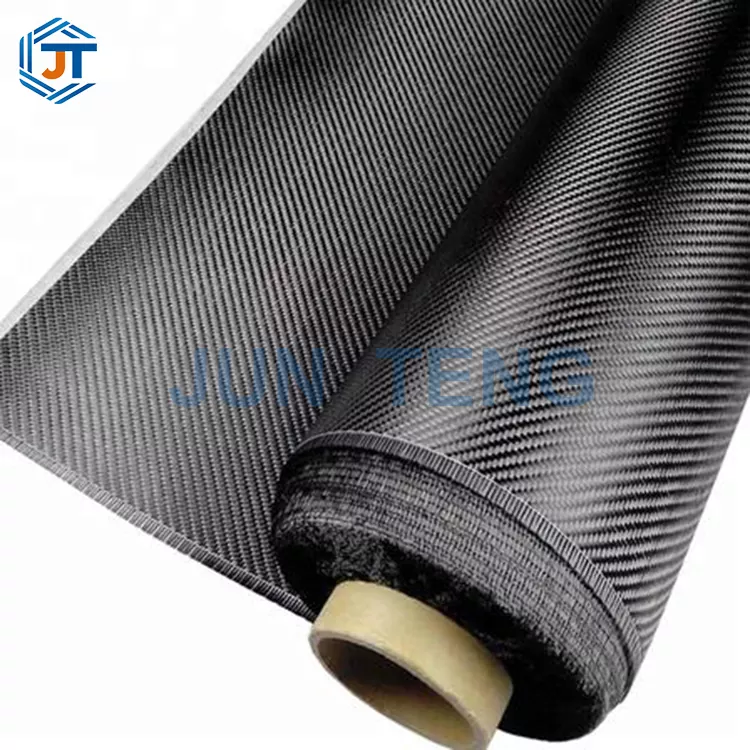
Cured Thickness Performance Benchmark
Based on JUN TENG’s third-party laboratory test data under standard processing conditions, the table below lists the typical single layer cured thickness range of the 200g Twill Carbon Fiber Woven Fabric under different common molding processes:
| Molding Process | Resin Content Range | Average Single Layer Cured Thickness | Thickness Tolerance |
|---|---|---|---|
| Hand lay-up | 55%-60% | 0.32mm | ± 0.03mm |
| Vacuum bag molding | 45%-50% | 0.28mm | ± 0.02mm |
| Autoclave curing | 40%-45% | 0.25mm | ± 0.015mm |
| Compression molding | 38%-42% | 0.23mm | ± 0.01mm |
Core Thickness Control Guidelines
- Precise resin content matching: The theoretical ideal single layer cured thickness of a standard 200g Twill Carbon Fiber Woven Fabric at 40% resin content is 0.25mm. Strictly controlling the resin to fiber ratio within the design range is the most critical step to keep the final thickness consistent.
- Uniform lay-up tension control: When laying the 200g Twill Carbon Fiber Woven Fabric on the mold surface, apply even and moderate tension along the warp and weft direction, to avoid local fabric wrinkling or excessive stretching that will cause uneven areal density and abnormal local thickness.
- Curing pressure stabilization: Maintain constant specified pressure during the full curing cycle. Too low pressure will lead to excessive residual resin and increased thickness, while too high pressure will squeeze out too much resin and cause insufficient interlayer bonding.
- Fabric pre-shrinking treatment: For high-precision parts, carry out 120℃ low temperature pre-shrinking treatment on the 200g Twill Carbon Fiber Woven Fabric before lay-up, to eliminate internal fabric stress and avoid thickness deviation caused by thermal shrinkage during high temperature curing.
200g Twill Carbon Fiber Woven Fabric FAQ
Q: What problem will happen if the actual cured thickness of each single layer of the 200g Twill Carbon Fiber Woven Fabric exceeds the design value by more than 0.05mm?
A: The total thickness of the final multi-layer composite part will far exceed the design tolerance, leading to assembly difficulty, increased part weight, and even the decline of structural stiffness that cannot meet the mechanical performance requirements of the component.
Q: Why does the twill weave structure of this fabric lead to a slightly different cured thickness range compared to a 200g plain weave carbon fiber fabric?
A: The twill weave has a more gentle interlacing path for carbon fiber tows, which leaves a small amount of uniform resin storage space between the weave undulations. This makes the cured surface show a more distinct and smooth twill texture, while the average cured thickness is about 0.02mm thicker than the plain weave variant of the same areal density.
Q: Can the cured thickness of the 200g Twill Carbon Fiber Woven Fabric be kept stable when used for large curved surface automotive body panel parts?
A: Yes. As long as operators follow the graduated lay-up sequence and use local pre-compaction for each curved surface area, the single layer thickness deviation across the entire large panel can be controlled within ±0.02mm, ensuring consistent overall panel thickness and surface texture uniformity.
As a specialized carbon fiber textile brand focused on consistent quality, JUN TENG provides every batch of 200g Twill Carbon Fiber Woven Fabric with official areal density test report and cured thickness reference data. Contact us today to get free custom weaving specification consultation and composite process technical support, to help your team achieve fully predictable part dimensional accuracy.