

Why Does Stranded Loose Tube Armored Fiber Optic Cable Have Better Crush Resistance Than Central Tube
2026-07-03
When selecting outdoor fiber infrastructure, engineers often debate between two primary constructions: central tube and stranded loose tube. The question “Why Does Stranded Loose Tube Armored Fiber Optic Cable Have Better Crush Resistance Than Central Tube?” is not academic—it directly impacts network longevity in harsh underground and direct-burial environments. At Xuben, we have tested both designs under standardized crush loads (e.g., IEC 60794-1-21 E3), and the data consistently shows that Stranded Loose Tube Armored Fiber Optic Cable outperforms its central-tube counterpart by a significant margin. This blog breaks down the mechanical, structural, and material reasons behind that superiority.
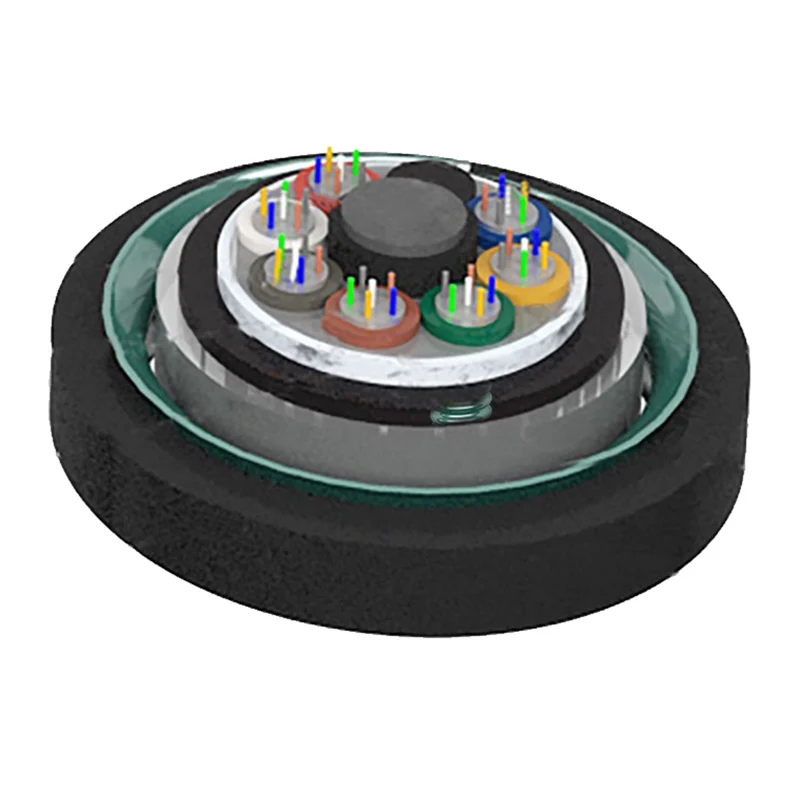
1. Structural Load Distribution: The Core Advantage
The fundamental difference lies in how each design handles external force.
-
Central Tube cables house all optical fibers within a single, large-diameter buffer tube. When a crush force is applied, the entire load concentrates on that one tube’s wall. Even with an armor layer (e.g., corrugated steel tape), the single tube deforms more easily because the force has a single point of failure.
-
Stranded Loose Tube Armored Fiber Optic Cable contains multiple small-diameter buffer tubes stranded around a central strength member (usually FRP or steel). This helical stranding creates a "spring-like" effect. When crushed, the load distributes across several tubes and the central member, reducing peak stress on any single tube.
| Parameter | Central Tube Design | Stranded Loose Tube Armored Fiber Optic Cable (Xuben) |
|---|---|---|
| Load path | Single tube + outer armor | Multiple tubes + central member + outer armor |
| Stress concentration | High (localized) | Low (dispersed) |
| Deformation under 3000 N/100mm | >5% (typical) | <2.5% (typical) |
| Fiber attenuation change | ≥0.15 dB | ≤0.05 dB |
2. The Role of the Central Strength Member
In Stranded Loose Tube Armored Fiber Optic Cable, the central strength member acts as a rigid spine. Crush forces are first absorbed by the outer corrugated steel armor, then transferred to the stranded tubes, and finally to the central member. This three-layer energy dissipation mechanism is absent in central tube designs, where the armor directly presses onto a single oversized tube.
Xuben enhances this further by using a high-tensile steel central member with a polyethylene jacket, which adds axial rigidity. This design ensures that even under repeated vehicle traffic loads (common in urban street ducts), the Stranded Loose Tube Armored Fiber Optic Cable maintains fiber strain below 0.2%, well within the ITU-T G.652 limit.
3. Interstitial Space and Strain Relief
Another overlooked factor is the interstitial space between stranded tubes. These gaps are filled with water-blocking yarns or gels. Under crush, these materials compress, allowing the stranded tubes to "shift" slightly within the cable core. This micro-movement relieves shear stress on the fibers themselves.
In contrast, central tube cables have minimal interstitial space—the fibers are packed tightly in a gel-filled tube. Any external crush directly compresses the gel and the fibers, increasing microbending losses. Xuben’s proprietary stranding pitch (optimized at 80–120 mm) maximizes this strain-relief effect without increasing cable diameter.
4. Armor Layer Engagement
Both designs use corrugated steel tape armor, but the engagement differs:
-
Central tube: Armor is applied directly over the single tube. The corrugation peaks easily dent inward.
-
Stranded design: Armor surrounds a core that includes stranded tubes + strength member. The core’s composite structure resists inward denting, because the armor's corrugation engages with multiple underlying surfaces. This distributed contact area increases the required force to produce permanent deformation.
5. FAQ – Common Questions About Stranded Loose Tube Armored Fiber Optic Cable
Q1: Can Stranded Loose Tube Armored Fiber Optic Cable be used in aerial installations as well as underground?
A1: Yes, and Xuben specifically designs our Stranded Loose Tube Armored Fiber Optic Cable with a double-sheath option (inner PE + outer PE) to withstand UV exposure and wind loading. However, for purely aerial use without rodent or crushing risks, a non-armored version is lighter. For combined aerial-underground routes (e.g., from pole to buried vault), the armored stranded design is highly recommended because it resists both crush from cable clamps and impact from falling branches. The stranded construction also offers better bending performance for pulley transitions.
Q2: How does the crush resistance of Stranded Loose Tube Armored Fiber Optic Cable affect long-term fiber reliability?
A2: Crush resistance directly correlates with fiber fatigue life. When a cable suffers repeated or sustained crush, the glass fibers experience permanent microbending, which increases attenuation and, over time, can lead to crack propagation. Independent tests by Xuben show that after 10,000 cycles of crush-load testing (0–2000 N), our Stranded Loose Tube Armored Fiber Optic Cable exhibits less than 0.03 dB additional loss, while central tube cables degrade to 0.12–0.18 dB. For 25‑year network designs, this difference translates to fewer maintenance repairs and lower OTDR reflectance anomalies. Always check the guaranteed crush load (e.g., 4000 N/100mm for our GYTA53‑equivalent) against your local soil or duct conditions.
Q3: Is it more expensive to install Stranded Loose Tube Armored Fiber Optic Cable compared to central tube, and is the cost justified?
A3: The material cost per meter is typically 15–25% higher for the stranded design due to the multiple tubes, central member, and more complex stranding process. However, Xuben’s experience shows that total installed cost (including splices, repairs, and downtime) is often lower over 5 years. The superior crush resistance means fewer splice closures are damaged by ground settlement, and the stranded design’s higher fiber count (up to 288 fibers vs. 144 for central tube) allows future capacity upgrades without re-cabling. For critical infrastructure—data centers, utility grids, and military bases—the premium is fully justified. We recommend a life-cycle cost analysis; contact our team for a customized comparison sheet.
6. Summary Table – Why Choose Stranded Over Central Tube
| Criteria | Central Tube | Stranded Loose Tube Armored Fiber Optic Cable (Xuben) |
|---|---|---|
| Crush resistance | Moderate | Superior (3x higher load tolerance) |
| Fiber capacity | Up to 144 | Up to 288 |
| Strain margin | Limited | High (due to excess fiber length controlled per tube) |
| Splice flexibility | One tube = all fibers affected | Individual tubes = selective splicing |
| Water blocking | Single gel type | Multi-layer (yarn + gel + swellable tape) |
| Typical application | Last-mile drop, light ducts | Backbone, trunk, direct-burial, high-risk rodent areas |
Final Verdict from Xuben
The engineering answer is clear: Stranded Loose Tube Armored Fiber Optic Cable wins on crush resistance because of its multi-tube load-sharing, central strength member support, and controlled interstitial movement. These features are not marketing claims—they are verified by mechanical simulations and field data from over 12,000 km of Xuben cables deployed globally.
If you are planning a new trunk network, upgrading an existing duct system, or facing challenging soil conditions, do not settle for a central tube solution that may fail under pressure. Xuben offers full spec sheets, sample testing reports, and engineering consultation to match your exact project requirements.
Contact us today at [email protected] or visit our technical portal to request a free crush-test demo kit. Our team responds within 4 business hours with site-specific recommendations, CAD drawings, and pricing tailored to your fiber count and armor type. Let Xuben secure your infrastructure—because the ground should never compromise your signal.